
If there’s one piece of advice I can give you for your best man speech, it’s this: build it around a single, heartfelt story, not a long list of jokes. You're aiming for that sweet spot between funny and sincere. Keep it tight—around three to five minutes is perfect—and always wrap it up with a warm toast to the happy couple. Your job is to honor your friend, not to try out for a Netflix special.
Your Guide to Delivering a Flawless Best Man Speech
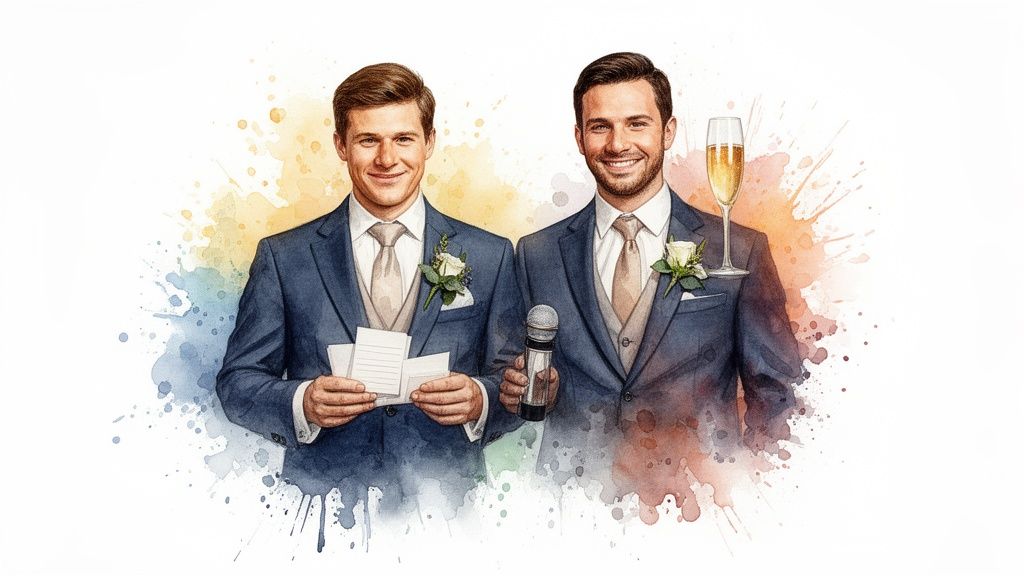
So, he asked you to be his best man. It's a huge honor, a true sign of what your friendship means. But that feeling of pride usually comes with a side of panic when you realize you have to give the speech. Let's be honest, it’s one of the most anticipated moments of the reception.
You’re not just getting up there to mumble a few words. You’re expected to capture years of friendship, celebrate a new marriage, and keep a room full of people entertained. The pressure is real. But the goal isn't to be perfect; it's to be genuine.
This guide will help you ditch the stale templates and tired wedding clichés. We're going to focus on finding your own voice to craft a speech that’s personal, memorable, and feels completely true to you and the groom.
Understanding the Importance of Your Role
Your speech is far more than a formality; it’s a tradition people genuinely care about. It used to be that the best man was literally the groom's armed bodyguard. Today, your words are your most important tool.
And people are listening. A 2023 YouGov poll found that 68% of people believe the best man's speech is an essential tradition. With over 2.1 million weddings in the US each year, you’re joining a legacy of about 1.4 million best man toasts delivered annually. No pressure.
Your speech is the bridge between the groom’s past and his future. It’s your chance to publicly honor your friend, officially welcome his new partner, and give everyone a glimpse into the bond you two share.
The Proven Structure for a Winning Speech
Staring at a blank page is the most daunting part. But here's the good news: the best speeches, whether from a best man, maid of honor, or father of the bride, all follow a simple, time-tested structure. This framework gives your toast a natural rhythm and keeps everyone hooked from your first line to the final "Cheers!"
Having a solid structure helps you organize your thoughts and ensures you hit all the right notes—a little humor, a little heart. Think of it as the blueprint for building your personal stories and well-wishes into something truly special.
Here’s a quick overview of the essential components for a well-balanced and engaging best man speech, designed to keep the audience captivated from start to finish.
The Perfect Best Man Speech Structure
| Section | Purpose | Recommended Time |
|---|---|---|
| The Opener | Grab attention, introduce yourself, and set a warm, engaging tone. | 15-30 seconds |
| The Core Story | Share a personal, meaningful anecdote about the groom or the couple. | 1-2 minutes |
| Acknowledge the Partner | Speak warmly about the groom's new spouse and their positive impact. | 30-45 seconds |
| The Closing Toast | Offer heartfelt wishes and raise a glass to their future. | 15-20 seconds |
Think of this table not as a rigid set of rules, but as a reliable guide. It provides a beginning, a middle, and an end, making sure you don't ramble and that your speech lands exactly as you intended—with heart and a whole lot of applause.
Finding Your Story and Setting the Right Tone

Before you write a single word, let's get one thing straight: the heart of a truly memorable best man speech isn't a string of killer jokes. It's a great story.
Your first job isn't to be a comedian; it's to be a storyteller. You need to dig through your shared history and find a memory that captures the essence of the groom.
You're looking for that perfect anecdote that shows who he is. When was he at his kindest? His most loyal? His most hilariously out of his depth? Those are the moments that connect with everyone in the room, from his high school buddies to his new great-aunt.
Brainstorming Your Core Anecdote
Give yourself some time to just think. Grab a notebook or open a document and let your mind wander through the years you’ve known him. Don't edit yourself yet—just get it all down. The best stories often come from the little details you’d almost forgotten.
Need a little help getting the memories flowing? Try these practical prompts:
- A "First" Moment: Think about the first time you met, the first time he gushed about his new partner, or the moment you knew he was a goner. These memories are naturally packed with emotion.
- A Moment of Growth: Was there a time he was in over his head and really stepped up? Sharing a story where he overcame a challenge shows his character in a powerful way.
- A Funny (but Kind) Mishap: A travel disaster, a ridiculous DIY project, a terrible fashion choice. These can be gold, as long as you're all laughing with him, not at him.
If you find yourself drawing a blank, a tool like Wedding AI can be a fantastic resource. It can prompt you with specific questions designed to shake loose those perfect, half-forgotten memories.
Balancing Humor with Heart
Okay, once you've found a few story ideas, you need to nail the tone. This is perhaps the single most important piece of advice you'll get: this is a toast, not a roast.
The line between a funny ribbing and a cringey insult is razor-thin, and a wedding reception is not the place to test that boundary.
Here’s a simple, practical rule: If you wouldn’t feel comfortable telling the story to the bride's grandmother one-on-one, it doesn't belong in the speech. Period.
Your job is to deliver a warm, heartfelt tribute that’s sprinkled with humor everyone can enjoy. Resist the urge to fill it with inside jokes. They’re a surefire way to alienate 90% of the room and make guests feel like they’re on the outside of a secret club. A good story invites people in.
Think of it this way: the humor should highlight the groom's lovable quirks, while the sincere moments should celebrate his character and the amazing couple they've become. Striking that balance is what separates a decent speech from a legendary one.
From Opening Line to Final Toast: Putting It All Together
Alright, you have your stories. Now comes the part where you turn those raw materials into a speech that flows. The secret isn't just stringing anecdotes together; it's about building a structure. Think of it as having a clear beginning, middle, and end.
This simple framework is what separates a rambling, hard-to-follow speech from a polished toast that captures the room. It gives your words a natural rhythm and guides everyone along with you.
Each piece has a job to do. When you get the structure right, you'll hold their attention from your first word to the final clink of glasses.
Nailing the Opening
You’ve got about ten seconds to make an impression. This is your moment to grab everyone's attention, introduce yourself, and set a warm tone. Whatever you do, don't waste it on a stale wedding joke you found on the internet.
Start with something simple and direct. Your goal is to immediately establish your connection to the groom and project warmth. You want people leaning in, not looking for the bar.
Here are a few practical ways to kick things off:
- Simple & Sincere: "For those of you who don't know me, my name is Mark, and I've had the honor of being John's best friend for the last fifteen years."
- The Shared Observation: "Good evening, everyone. If you look at John tonight, you'll see a man who is completely, undeniably happy. And I've never seen him happier than when he's with Sarah."
- The Gentle Tease: "My name is Mark, and it’s my job tonight to tell you what a great guy John is. The only challenge is, they only gave me three minutes to do it."
Building the Middle with Your Story
This is the heart and soul of your speech. It's where you'll share that core anecdote you chose earlier to show, not just tell, what kind of person the groom is.
Find a natural way to transition into your story. Something as simple as, "I knew he was a truly loyal friend when..." or "The moment I really understood what Sarah meant to him was..." works perfectly. This is the bridge that takes the audience from your introduction to the main event.
As you tell the story, always keep one question in mind: Why this story, and why now? You must connect it back to the present moment. Explain how that memory reveals something about the great husband he is about to become.
Creating a Memorable Close
This is your dismount. It’s the last thing people will hear from you, so make it count. The closing needs to be concise, heartfelt, and aimed squarely at the happy couple. Don't introduce new ideas or try to cram in one last joke. Your job now is to land the plane smoothly.
A great closing does two things: it summarizes your core message and directs everyone’s goodwill toward the couple. It’s the emotional peak of your speech, leaving everyone feeling uplifted and ready to celebrate.
A sophisticated move is to bring your speech full circle by referencing your opening line or the main theme of your story. From there, address the couple directly, offer your sincere wishes for their future, and then—critically—raise your glass and tell people what to do. That clear call to action provides the classic, perfect ending.
Wedding speeches are changing. In a post-pandemic world, 92% of couples are asking for 'authentic' over formal. Personal stories have an 85% higher emotional resonance with guests. The best man's speech remains the one everyone waits for, kicking off the toasts at 78% of 2025 receptions. You can find more great insights into modern wedding toasts at hitched.co.uk.
Polishing Your Draft for Maximum Impact
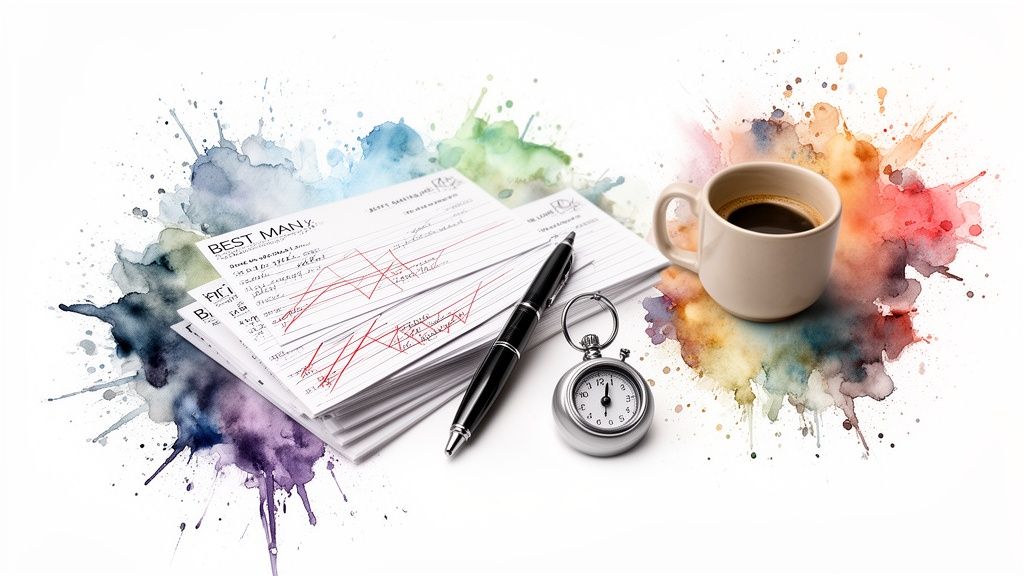
A good speech is written, but a phenomenal speech is rewritten. Think of your first draft as a block of marble—you have the raw material, but now it’s time to chip away everything that isn't part of the final masterpiece.
This is where you shift gears from storyteller to editor. It’s this part of the process that turns a decent toast into one that people will still be talking about at the first anniversary. Don't rush it; this polish is what makes the whole thing shine.
The Power of Reading Aloud
If I could give you only one piece of editing advice, it would be this: read your speech out loud. What looks great on paper can sometimes sound clunky or awkward when spoken.
Reading your speech aloud works magic for a few reasons:
- You'll find the awkward phrases. Your tongue will trip over weird phrasing, overly long sentences, or words that just don’t sound like you.
- You can feel the comedic timing. A joke's rhythm is everything. Hearing it will instantly tell you if the punchline lands or falls flat.
- You'll begin to memorize it naturally. The more you say the words, the less you'll need your notes. This means more eye contact and a more genuine connection with the couple and the crowd.
This simple, actionable step takes your speech from a document and turns it into a performance. You can do it in front of a mirror, record a voice memo on your phone, or ask a trusted friend for honest feedback.
The goal is to sound like you're having a conversation, not reading an essay. If a line makes you stumble or feels forced, rewrite it until it flows naturally.
Timing is Everything
Let’s talk numbers. The sweet spot for a best man speech is between three and five minutes. Anything shorter might come off as abrupt. Anything longer, and you risk seeing people check their watches.
Wedding guests have a notoriously short attention span, so brevity is your best friend.
A practical tip is to use your phone’s stopwatch and time yourself reading at a natural, conversational pace—not rushing. As a benchmark, most people speak around 120-130 words per minute. So, a solid script will be between 360 and 650 words.
If you’re running long, it's time to be ruthless. Cut any story that isn't absolutely essential. If a joke feels like a detour or a detail doesn’t serve the main point, it has to go. It's always better to leave the audience wanting more than wishing you would wrap it up.
If you’re stuck on trimming your draft, a tool like Wedding AI can be surprisingly helpful. It can help you tighten your phrasing and spot any clichés you might have missed, giving you a final draft that feels polished and ready.
Mastering Your Delivery and Conquering Nerves

Alright, you've done the hard work. Your stories are gathered, your jokes are appropriate, and the heartfelt bits are down on paper. You’ve polished it until every word feels right. Now for the final hurdle: actually giving the speech.
Even the most brilliant words can fall flat with a shaky delivery, so this part is every bit as crucial as the writing itself.
Let's be honest, public speaking can be terrifying. If your heart is pounding just thinking about it, you’re not alone. In fact, many a best man has found the speech far more intimidating than any other part of the job.
The goal isn't to suddenly transform into a world-class orator. It's simply to manage those nerves enough to let your genuine warmth and personality come through. A few practical tricks can get you to the microphone feeling ready and confident.
Before You Speak: Calming the Jitters
The moments right before your name is called are usually the worst. Adrenaline is pumping, and your mind starts racing. Instead of letting that anxiety hijack the moment, you can channel it into focus with a few grounding techniques.
These small, practical actions can make a world of difference:
- Breathe intentionally. Just before it’s your turn, take a few slow, deliberate breaths. Inhale for a count of four, hold for four, and then exhale slowly for six. This simple trick actually slows your heart rate and helps clear your head.
- Visualize success. Close your eyes for a second and picture yourself nailing the speech. See the smiles, hear the laughter, and imagine the applause at the end. A positive mental walkthrough is a powerful confidence booster.
- Reach for water, not whiskey. It’s tempting to grab a drink for liquid courage, but too much alcohol can sabotage your timing and your words. Stick with water until your toast is done—you'll thank yourself later.
Here's a simple truth to hold onto: Everyone in that room is on your side. They are all there to celebrate the same people you are, and they genuinely want to hear what you have to say. They are rooting for you.
On Stage: Nailing the Physical Delivery
Once you’re up there, it's not just about what you say—it's how you say it. Your body language, your eye contact, and the pace of your voice play a massive role in keeping everyone engaged.
The data backs this up. It’s no surprise that 75% of best men admit to fearing the speech more than planning the bachelor party. Speeches that land around the 4.2-minute mark get the best reactions, but go over five minutes, and you risk losing 40% of the room's attention. Even small details, like starting with a thoughtful quote, can boost engagement by 25%. For more tips, check out The Knot's latest findings on crafting a great wedding speech.
Focus on these key, actionable elements to connect with your audience:
- Plant your feet. Find a comfortable stance with your feet shoulder-width apart. This prevents the nervous rocking or pacing that can distract your audience. A solid stance projects confidence, even if you don't feel it.
- Slow down. When we get nervous, we tend to speed up. Make a conscious effort to speak more slowly than you would in a normal conversation. Don't be afraid to pause between sentences to let your points land.
- Make eye contact. Avoid staring a hole into your notecards or a random spot on the back wall. Scan the room, making brief eye contact with different guests. Most importantly, bring your focus back to the happy couple. After all, this is all for them.
Your Top Best Man Speech Questions, Answered
Alright, you’ve put in the work. You've brainstormed, written, and practiced. But a few last-minute questions might still be swirling in your head. That's completely normal.
Think of this as your final pre-game pep talk before you step up to the mic.
How Long Should This Thing Actually Be?
The ideal length for a best man speech is between three and five minutes. That’s all you need. It’s just enough time to share a great story, say something meaningful, and raise a glass without seeing guests start to check their watches.
An easy, practical way to check your timing is to read the speech out loud at a conversational pace. If you're pushing past five minutes, it’s time to be ruthless with your editing. Find a sentence here or a detail there that you can trim.
A short, punchy speech that leaves people smiling is always better than a long one that drags on. Brevity is your best friend.
Can I Use Notes? Or Is That Cheating?
Yes, you absolutely can and should use notes. Unless you give presentations for a living, having notes is not just okay—it's smart. It shows you cared enough to prepare and frees you from the pressure of memorizing every last word.
But here’s the practical trick: don’t bring a full sheet of paper up there with you. That encourages you to read word-for-word with your head down. Instead, jot down your main points on a few small index cards. Think of them as your guideposts, not a script. This helps you maintain that all-important eye contact and sound more conversational.
What Topics Are Completely Off-Limits?
Your one job is to celebrate the happy couple and make them feel great. To do that, you must keep the vibe positive, warm, and appropriate for everyone in the room—from their college friends to their great-aunt Susan. Knowing what not to say is half the battle.
Here are the topics to steer well clear of:
- Past relationships: Do not, under any circumstances, mention exes. It’s incredibly awkward for the couple and makes everyone in the room cringe.
- Genuinely embarrassing stories: There’s a huge difference between a funny, lighthearted jab and a story that’s actually humiliating. If it feels more like a roast than a toast, it has to go.
- Inside jokes: If only two people in a room of a hundred will get the joke, you’ve lost your audience. Your speech needs to bring everyone in, not leave 99% of the guests out.
- Any complaints: This isn't the time to grumble about the cost of the tux rental or the logistics of the bachelor party. Keep it positive.
Here’s a great rule of thumb: If you wouldn’t be comfortable saying it in front of the bride’s grandparents, cut it. When in doubt, leave it out.
Feeling the pressure to get your speech just right? Wedding AI can help you brainstorm personal stories, organize your thoughts, and polish your draft until it's perfect. It’s like having a trusted writing partner dedicated to making your toast unforgettable. Transform your memories into applause at https://weddingai.com.


