
The moment you're asked to be the best man is an incredible honor, often followed by a single, slightly terrifying thought: "I have to give a speech." It's a task that can make even the most confident person feel a little nervous. You want to be funny but not embarrassing, heartfelt but not overly sentimental. You're aiming to honor your friend, celebrate this wonderful new marriage, and hold the attention of a room full of people. It can feel like a high-wire act.
But here’s the secret: a great best man speech isn't about being a perfect orator or a stand-up comedian. It's about being a great friend. It's about sharing something true and personal that illuminates who the groom is and why his partnership is something worth celebrating. The best material is already in your shared memories. This collection of best man speech tips is designed to help you find those moments and shape them into something that feels authentically you.
We'll move beyond the clichés and into practical, actionable advice. You'll learn how to structure your thoughts, balance humor with genuine emotion, and deliver your words with a quiet confidence. Think of this as a conversation with a trusted friend who's been there before. Together, we'll craft a speech that not only earns applause but, more importantly, serves as a meaningful gift to the new couple on their most important day.
1. Start with a Strong Personal Story
Forget the generic, "For those of you who don't know me..." The fastest way to lose an audience is to start with a cliché. Instead, one of the most effective tips you can use is to launch directly into a compelling personal anecdote about the groom. This technique immediately grabs everyone's attention, establishes your unique connection, and grounds your speech in authentic emotion from the very first sentence.
Your opening story is your hook. It should be a short, vivid snapshot that reveals something meaningful about the groom's character—his loyalty, his humor, his kindness. You're not just telling a random tale; you're strategically choosing a moment that you can later connect to his new life with his partner.

Why This Approach Works
Starting with a story bypasses formalities and creates an instant bond with your audience. People connect with narratives far more than with abstract statements. Saying, "John is a loyal friend," is fine, but telling a two-sentence story about the time he drove three hours in a snowstorm to help you with a flat tire is infinitely more impactful. It shows his loyalty instead of just telling it. This method sets a warm, personal tone for your entire speech.
How to Choose the Right Opening Story
Your story doesn't need to be a dramatic, life-altering event. Often, the small, specific moments are the most powerful. Consider these prompts to find your perfect opener:
- The "First Meeting" Story: Think back to the very first time you met the groom. Was it awkward or funny? For example: "The first time I met Mark was in college. He was trying to convince our RA that a hot plate didn't count as a 'cooking appliance' if you only used it to make grilled cheese. That’s when I knew I'd found a lifelong friend: a man of principle, and of perfectly melted cheddar."
- The "Defining Trait" Story: Choose a memory that perfectly encapsulates a core part of his personality. If he's incredibly generous, tell the story of him giving his favorite jacket to a friend in need without a second thought.
- The "Moment of Growth" Story: Recall a time when you saw him overcome a challenge. This can be a touching way to show his journey to the man he is today.
When you're brainstorming, try to pick a story with a clear, simple arc. Aim to keep it concise, ideally under a minute, to maintain the speech's momentum. Most importantly, ensure the story transitions smoothly into celebrating the couple. If you're struggling to frame your best memories, a tool like Wedding AI can help you structure your anecdotes effectively.
2. Balance Humor with Heartfelt Sentiment
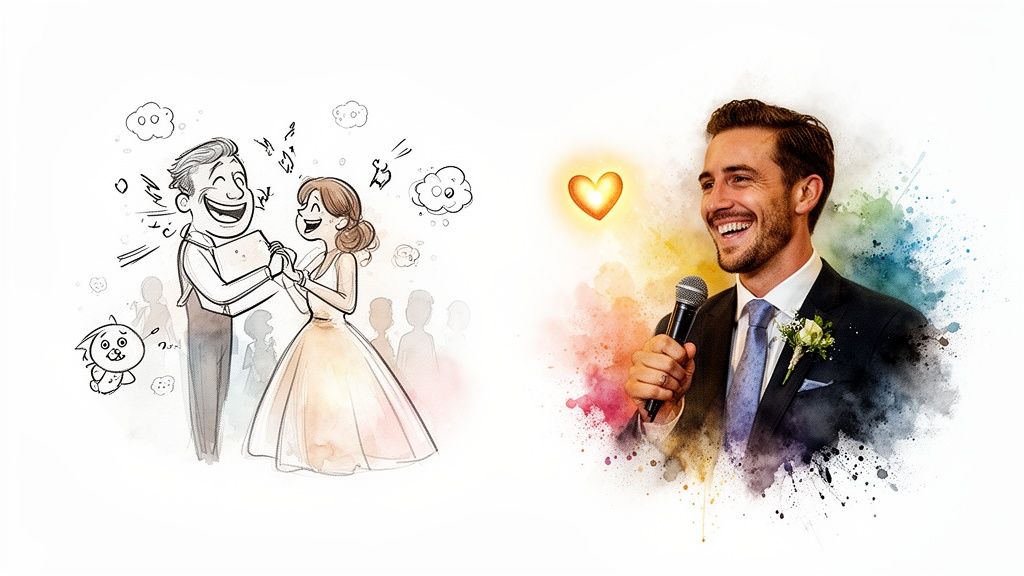
The most memorable speeches, whether from a maid of honor or a father of the bride, are rarely just a string of jokes or an overly sentimental monologue. They are a masterful blend of both. Finding the right equilibrium between humor that entertains and heartfelt emotion that resonates is a crucial skill. This balance keeps your audience captivated, taking them on a small journey from laughter to a touching "aww" moment.
Achieving this balance is an art. Too many jokes can make the speech feel shallow or like a roast that dismisses the gravity of the occasion. On the other hand, a speech that is purely sentimental can become heavy and lose the celebratory energy of the room. Your goal is to weave them together, letting a funny anecdote seamlessly transition into a sincere observation.
Why This Approach Works
Alternating between humor and heart creates a dynamic rhythm that holds an audience’s attention. Laughter relaxes people, making them more receptive to the emotional moments that follow. When you share a funny story about the groom’s questionable fashion choices in college and then pivot to how his partner has brought out his best, the contrast makes the sentiment more powerful. It shows the positive impact of the relationship in a way that feels authentic and earned.
How to Achieve the Right Balance
Finding the perfect mix requires conscious planning. You need to structure your speech to flow naturally between lighthearted and meaningful moments. Here are a few practical ways to do this:
- The 70/30 Guideline: Aim for a speech that is roughly 70% lighthearted stories and humor, and 30% sincere, meaningful sentiment. This keeps the overall tone upbeat while ensuring the core message of love and friendship shines through.
- Use Transitional Pivots: Create smooth bridges between your jokes and your heartfelt points. For instance: "For all the times I’ve seen him trip over his own feet, I’ve never seen him more sure-footed than when he’s walking toward you." This directly connects a funny observation to a sincere compliment.
- End with Emotion: While it's great to start with a funny story, you should always aim to conclude on a heartfelt note. Your final words should be a warm, sincere wish for the couple's future. This ensures the lasting impression is one of love and support.
- Reference the Partner Directly: When you shift from a funny story about the groom to a more sincere moment, turn your focus to his partner. Acknowledging them directly is the most natural way to pivot toward the heart of your speech, which is the celebration of their union.
3. Keep It Concise and Well-Paced (3-5 Minutes)
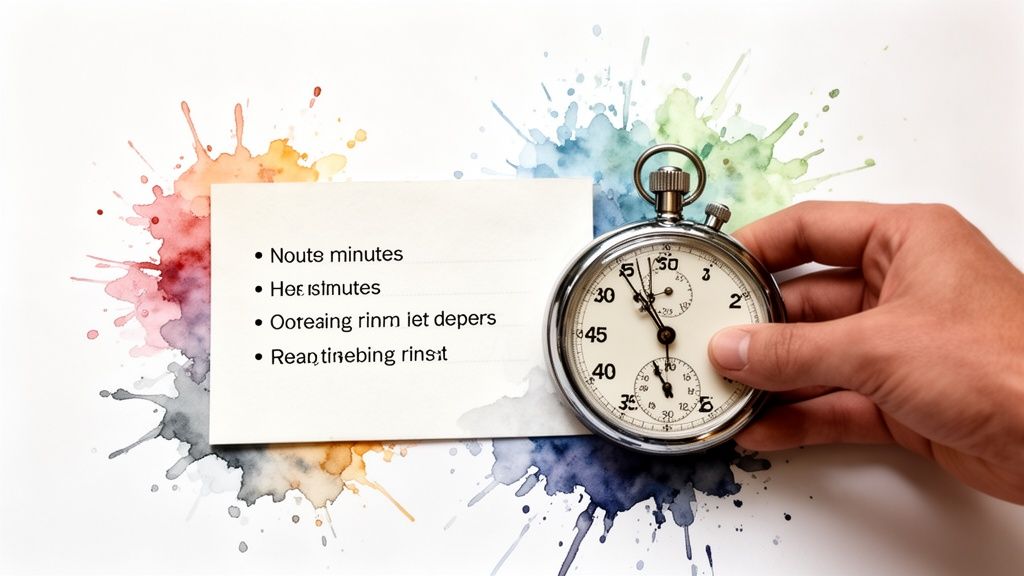
The best speeches are often not the longest. One of the most critical tips you can follow is to respect everyone's time by aiming for a sweet spot of three to five minutes. This length is long enough to share a meaningful story and express genuine emotion but short enough to keep every guest engaged. Anything longer risks losing momentum and the attention you worked so hard to capture.
Proper pacing is just as important as the words themselves. It’s the rhythm of your delivery—the strategic pauses after a punchline and the steady build-up to a heartfelt conclusion. A well-paced three-minute speech can feel more profound and impactful than a rambling ten-minute one because every sentence serves a purpose. It ensures your key messages have the space they need to land.
Why This Approach Works
A concise and well-paced speech shows respect for the couple, the guests, and the event's schedule. In the context of a wedding reception with multiple speakers, food courses, and dancing, brevity is a gift. A focused structure also forces you to be a better editor, cutting out weak jokes or irrelevant details and leaving only your strongest material. This discipline results in a tighter, more powerful narrative that shows you’ve put thought and care into your tribute.
How to Master Your Timing and Pacing
Achieving the perfect 3-5 minute length is a science. A typical speaking rate is about 130-150 words per minute, so your final script should be around 400-650 words. Here are some actionable tips to nail your delivery:
- Practice with a Timer: The single best way to get your timing right is to rehearse out loud with a stopwatch. You’ll be surprised how long three minutes actually feels. Record yourself to hear where you’re rushing or where a pause could add dramatic effect.
- Write Long, Then Cut Ruthlessly: Write your first draft without worrying about length. Get all your ideas down. Then, go back and cut it by at least 20%. Ask yourself if each sentence adds real value. If it doesn't, it goes.
- Structure Your Time: Allocate your time intentionally. For example, a four-minute speech could be broken down like this: 45 seconds for your opening story, 90 seconds for anecdotes about the groom and the couple, 60 seconds to speak about his partner and their relationship, and 45 seconds for the final toast.
- Build in Pauses: Silence is a powerful tool. Mark moments in your script to pause deliberately—after a funny line to let the laughter build or before a sincere compliment to let the emotion sink in.
4. Acknowledge and Celebrate Their Partner
While your primary connection is with the groom, remember that the day is about the couple. A speech that only focuses on the groom feels incomplete. The best speeches thoughtfully acknowledge and celebrate his partner, showing you understand and honor the significance of their new life together.
This isn't just about saying a few nice words; it's about demonstrating your recognition of how they have positively impacted your friend and your genuine happiness for their shared future. By celebrating them, you validate the groom's choice and welcome them into your circle of friendship, which is a powerful and gracious gesture.
Why This Approach Works
Acknowledging the groom's partner transforms your speech from a simple tribute to your friend into a true celebration of their marriage. It shows emotional intelligence and maturity, reassuring their family and friends that the groom's inner circle fully embraces this union. Praising the groom is expected, but explaining why his partner is perfect for him is what makes a speech truly memorable and heartfelt. It shows you see the groom not just as your friend, but as a man who has found his other half.
How to Authentically Celebrate Their Partner
You don't need to have known the groom's partner for years to speak about them meaningfully. Focus on your observations of their character and their effect on the groom.
- Highlight Their Positive Influence: Think about how the groom has changed for the better since meeting them. Is he happier, more adventurous, or more organized? Frame it with a specific, lighthearted example. For instance: "Steve, I've watched you become a better man since Sarah came into your life. And I'm not just saying that because you finally learned how to separate your laundry. I'm saying it because I've never seen you so genuinely happy."
- Show, Don't Just Tell: Instead of saying "She's so kind," share a brief observation. Mention a time you saw her do something thoughtful or how she supports the groom's passions. Specifics make your compliments feel real.
- Welcome Them to the Group: A direct, warm welcome is incredibly effective. A simple line like, "On behalf of all of Steve's friends, Sarah, we couldn't be more thrilled to officially welcome you to the family," makes a significant impact. It’s a simple gesture that communicates acceptance and joy.
5. Avoid Clichés and Overused Phrases
Wedding speeches can sometimes rely on tired tropes like "marriage is a journey," or quoting a dictionary definition of love. These phrases, while well-intentioned, instantly dilute the authenticity of your message. One of the most important tips you can follow is to replace these generic placeholders with fresh language and your own observations.
This doesn't mean you need to be a professional poet; it simply means finding your own voice. The goal is to deliver a tribute so specific to the couple that it couldn't possibly be given for anyone else. Freshness and specificity are what separate a truly memorable speech from a forgettable one.
Why This Approach Works
Avoiding clichés makes your speech feel genuine. When you use your own words to describe the couple's unique bond, the audience leans in because they recognize the truth in what you're saying. Generic phrases create distance, but specific details build an immediate connection. Stating, "Sarah and Tom are soulmates," is a claim, but describing the specific moment you realized their unique compatibility is compelling proof.
This method forces you to dig deeper into your memories, resulting in richer, more meaningful content. It shows the audience the couple's love story through your eyes rather than just telling them about it with borrowed phrases.
How to Find Your Original Language
The key to originality is swapping broad statements for specific evidence. Instead of relying on a common phrase, think about the real-life moment that makes that phrase true for this specific couple.
- Instead of "Marriage is a journey"... Describe a specific adventure they took together that tested them. "People say marriage is a journey, but for Mike and Jess, that journey involved a broken-down van, a 20-year-old map, and the shared belief they could fix anything with duct tape. And they did."
- Instead of "They complete each other"... Pinpoint an example of how their different personalities complement one another. "He’s the calm in her storm, and she’s the one who reminds him that sometimes you just have to dance in the rain."
- Instead of "I knew they were perfect for each other when"... Describe that exact moment. "I knew they were perfect for each other when, during a ridiculously competitive board game night, David deliberately made a bad move so Emily could win. For those who know David, you understand that’s a love deeper than the Mariana Trench."
As you write, read your draft aloud. If a phrase sounds like it could be from a greeting card, flag it for revision. This is your story to tell, so use your language.
6. Practice Your Delivery
Even the most brilliantly written words can fall flat without a confident delivery. A common mistake is to spend all your time perfecting the text on the page while neglecting how it will actually sound in the room. You have to master your presentation, transforming your well-crafted speech from mere words into a memorable performance.
The goal isn't to sound robotic or over-rehearsed; it's the opposite. True mastery comes when you've practiced so much that the speech feels natural and conversational. This means internalizing the flow so you can deliver your words with authentic emotion, making eye contact, and connecting with the couple and the audience.
Why This Approach Works
Great delivery is the bridge between your good intentions and the audience's emotional response. When you speak clearly and control your pacing, you guide your listeners through the story. A practiced delivery shows confidence and respect for the occasion. It proves you put in the effort, which makes your tribute to the couple feel that much more significant.
How to Practice Effectively
True rehearsal goes beyond simply reading your speech in your head. It requires deliberate, active practice to build muscle memory and confidence. Use these techniques to polish your presentation:
- Record Yourself: Use your phone's voice memo or video recorder to capture a full rehearsal. Listening back is the fastest way to identify awkward phrasing, filler words like "um" or "like," and a monotone delivery. It provides invaluable, objective feedback.
- Rehearse in Front of a Friend: Practice in front of a trusted friend or family member. This simulates the pressure of a live audience and helps you gauge which jokes land and which stories connect. Ask for their honest thoughts.
- Time Every Run-Through: Clock your speech from start to finish multiple times. This ensures you stay within the ideal 3-5 minute window and helps you understand your natural pace. If you're consistently running long, you know exactly where to trim.
- Familiarize Yourself with the Venue: If possible, do a quick dry run at the venue beforehand. Get comfortable standing at the microphone. This small step can significantly reduce day-of jitters.
Aim to rehearse aloud at least 5 to 7 times. Your final run-through should feel comfortable and almost second nature, freeing you up to focus on connecting with everyone on the big day.
7. Share a Thoughtful Observation About the Groom
A truly memorable speech goes beyond funny stories and generic compliments. To elevate your speech from good to great, share a thoughtful observation about the groom's character or how he has grown as a person. This approach provides depth, showing guests a side of the groom they may not know and honoring the journey he's taken to this milestone.
This isn't about listing his good qualities. It's about creating a narrative arc that moves from ‘who he was’ to ‘who he is now,’ especially in the context of his new partnership. By highlighting his evolution, you celebrate not just the man he is today but also the positive influence his partner has had on his life.
Why This Approach Works
Sharing observations about the groom’s growth makes your speech incredibly personal. It demonstrates the depth of your friendship and proves you’ve paid attention to his life, which is a powerful compliment. It shows guests that this marriage isn't just a happy event but a meaningful culmination of personal development. Saying "Dave has become a better man since meeting Sarah" is one thing, but illustrating it with a specific observation makes it profoundly impactful.
How to Uncover These Observations
Reflecting on your friendship is the key to finding these powerful insights. You aren't looking for flaws; you're looking for growth. Consider these angles to find the perfect observation:
- From Restless to Rooted: "I remember when Mike’s idea of a five-year plan was figuring out which music festival to go to next. But seeing him with Jessica, I’ve watched him find a sense of purpose and direction I always knew he had. He’s gone from searching for the next big thing to building something truly lasting."
- From Guarded to Open: Highlight how his partner has brought out a new side of him. "For years, the deepest emotion I saw from Chris was his frustration over a bad fantasy football trade. Then he met Emily, and I watched him become this incredibly vulnerable, open-hearted person. She gave him the confidence to show the person we all knew was there."
- Enhancing a Core Trait: Connect a long-standing positive quality to his new life. "Alex has always been the most loyal guy I know. Now, seeing that fierce loyalty directed toward Maria, I know he’s found the perfect person to give that incredible part of himself to."
When you craft these observations, always frame them positively. The goal is to celebrate his journey and show how his partner completes it, not to critique his past.
8. End with a Clear, Heartfelt Toast
The final words of your speech are what guests will remember most. Your closing toast is your chance to deliver a powerful, concise, and emotionally resonant send-off. A strong toast provides a unifying moment for everyone in the room, tying together all the stories and sentiments you've shared into one final, celebratory act.
Your toast is the exclamation point on your speech. It should be a clear and direct invitation for everyone to raise their glasses and join you in celebrating the newlyweds. It’s the moment you transition from speaking about the couple to speaking to them and leading the room in a shared gesture of support.

Why This Approach Works
Ending with a clear toast provides essential structure and a satisfying conclusion. It prevents your speech from fizzling out awkwardly and gives guests a specific action to perform, making them active participants rather than passive listeners. This shared action creates a powerful sense of community and collective joy, leaving a lasting impression of unity.
How to Craft the Perfect Closing Toast
A memorable toast is personal yet universal, brief yet impactful. It should feel like the natural conclusion to the story you've just told. Consider these elements for a flawless finish:
- Keep It Short and Sweet: Your toast should be no more than two or three sentences. For example: "I've known [Groom] my whole life, and I've never seen him happier. [Partner], thank you for bringing that incredible smile to his face. Please join me in raising a glass to a lifetime of love and laughter for the happy couple!"
- Be Direct and Inclusive: Use clear, inviting language. Phrases like, "So, let's all raise our glasses to..." or, "Please join me in a toast to..." are explicit calls to action that guide the room.
- Make It Personal, But Not Private: Address the couple by name. The toast should feel connected to your speech but broad enough for everyone to relate to. A great example is: "[Groom], you're a brother to me, and [Partner], you are the perfect person for him. To new beginnings, shared dreams, and a love that lasts forever. Cheers!"
- Land the Landing: Practice your toast separately so you can deliver it with confidence and eye contact. Raise your own glass slightly as you begin to signal what's coming. After your final word, like "Cheers!", pause for a moment to let the sentiment sink in before you take a drink.
8-Point Best Man Speech Comparison
| Strategy | Implementation complexity | Resource requirements | Expected outcomes | Ideal use cases | Key advantages |
|---|---|---|---|---|---|
| Start with a Strong Personal Story or Memory | Medium — needs curation and pacing | Low–Medium — time to choose and test story | High engagement, immediate rapport | Best men / close friends with good anecdotes | Emotional resonance; credibility; memorable opening |
| Balance Humor with Heartfelt Sentiment | High — requires smooth tonal shifts | Medium — rehearsal, audience sense-checks | Strong emotional impact; sustained attention | All speakers aiming for lasting impact | Keeps audience engaged; authentic and varied tone |
| Keep It Concise and Well-Paced (3–5 Minutes) | Medium — tight editing and timing | Medium — drafts, timed rehearsals | Clear, memorable message; respects schedule | All speakers; events with tight timelines | Memorable, quotable, respects event flow |
| Acknowledge and Celebrate their Partner | Low–Medium — needs authentic phrasing | Low–Medium — brief info from groom or bride | Inclusive tone; goodwill with guests | Best men and close friends in mixed audiences | Demonstrates respect; strengthens couple-focused narrative |
| Avoid Clichés and Overused Phrases | Medium — requires revision and creativity | Low — time to rewrite or use tools | More authentic, memorable speech | Speakers seeking originality | Originality; reduces audience tune-out |
| Practice Your Delivery | Medium — disciplined rehearsal (risk of overpractice) | High — repeated rehearsals, recordings, feedback | Confident, polished delivery; fewer mistakes | Nervous speakers; first-time public speakers | Reduces anxiety; improves pacing and presence |
| Incorporate Thoughtful Observations About the Groom's Growth or Character | Medium — reflective writing and examples | Medium — time to recall and verify stories | Emotional depth; coherent narrative arc | Long-time friends or family with insight | Adds gravitas; shows deep knowledge and growth |
| End with a Clear, Heartfelt Toast That Invites Participation | Low — concise closing craft | Low — brief practice for delivery | Memorable finale; collective participation | All speakers; formal ceremonial close | Unifying moment; repeatable, emotionally resonant closing |
You've Got This: Your Final Checklist
The index cards are written, the stories are polished, and the moment is almost here. Any nerves you might be feeling are completely normal; they reflect how much you care about your friend and this milestone in his life. The most important thing to remember is that you've already done the hard work. By following these tips, you have laid the groundwork for a truly memorable and meaningful speech.
The core of your speech isn't about being the funniest person in the room. It's about authenticity. It’s about sharing a genuine piece of your friendship, honoring the person the groom has become, and celebrating the incredible partnership he has found. If you have focused on a strong personal story, balanced your humor with genuine sentiment, and paid sincere tribute to his new spouse, you have already succeeded.
The Final Polish: From Good to Unforgettable
Before you tuck your notes into your jacket pocket, run through this final checklist. This isn't about rewriting your speech; it's about fine-tuning the delivery and mindset that will elevate your words.
- Review Your Pacing One Last Time: Read your speech aloud with a timer. Are you comfortably within that three to five-minute sweet spot? If you're rushing, identify one less critical detail to trim.
- Practice Your Pauses: The silence between your sentences is just as powerful as the words themselves. Rehearse where you will intentionally pause—perhaps after a funny line to let the laughter build, or before a heartfelt compliment to give it weight.
- Ground Yourself Physically: Nerves can manifest physically. Before you are called up, take a few deep, slow breaths. Plant your feet firmly on the ground. When you get to the microphone, take a moment to adjust it, make eye contact with the couple, and smile. This small routine signals that you are ready.
Embracing the Moment
Remember, the audience is your ally. Every single person in that room is there to celebrate. They are rooting for you. They want to hear your stories and share in this joyous occasion. They are a warm, receptive crowd eager to connect with your message.
The true impact of your speech will come from the heart of it all: your relationship with the groom. Trust that bond. When you speak from that place of genuine affection, your sincerity will resonate far more than any perfectly crafted joke. You are not just giving a speech; you are offering a gift—a spoken tribute to a friend you love. You have all the best man speech tips you need.
You are uniquely positioned to give this speech because of who you are to the groom. You have a perspective no one else has. Honor that. Share it with warmth and confidence. You've got this. Go make your friend proud.
Feeling the pressure to get every word just right? Wedding AI can be your personal speechwriting assistant. It helps you organize your best stories, find the perfect tone, and structure a heartfelt toast that sounds exactly like you, ensuring you deliver one of the most memorable moments of the night. Visit Wedding AI to craft a speech with confidence.


