
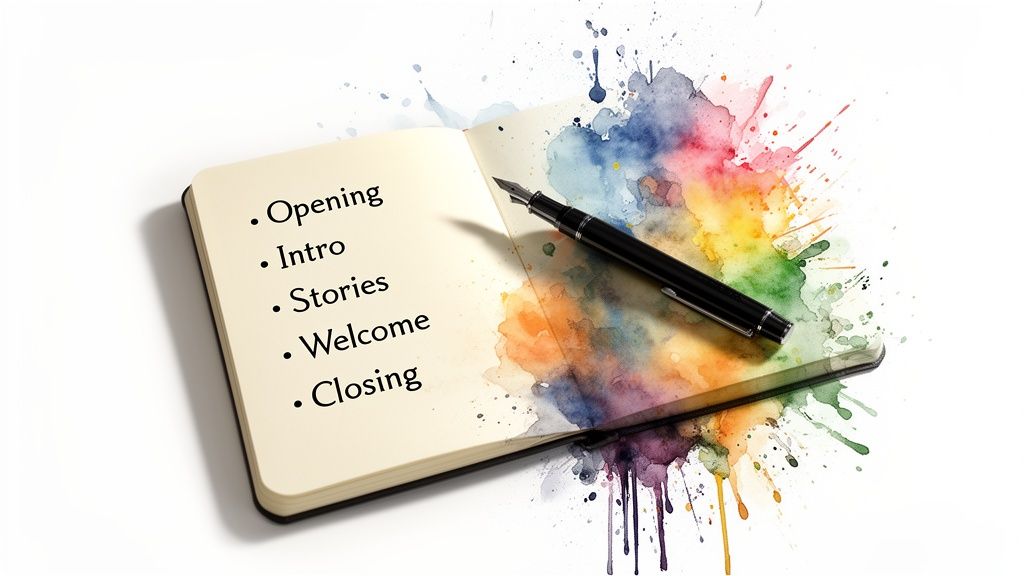
Delivering a killer best man speech isn't about becoming a professional comedian or a world-class orator overnight. It’s about having a plan. Your roadmap is a simple, five-part outline: a killer opening, a quick introduction, a couple of great stories, a warm welcome to the new spouse, and a strong toast to finish.
This structure is your secret weapon. It ensures you connect with the audience, honor your friend, and, most importantly, don't ramble.
The Essential Blueprint for a Great Speech
Staring at a blank page can feel like the hardest part. But you don't have to reinvent the wheel. The most memorable speeches follow a similar, time-tested pattern that simply works.
Think of it less as writing from scratch and more like building with a proven blueprint. The framework is already set; you just need to bring the raw materials—your personal stories, inside jokes, and genuine feelings for the happy couple. Every piece has a specific job, from grabbing everyone's attention at the start to leaving them with a heartfelt toast.
This simple flow breaks the process down into three main acts: the intro, the stories, and the toast.
Following this structure allows you to focus on what truly matters—telling a great story—instead of getting bogged down in what to say next.
Understanding the Core Components
Whether you're the best man, maid of honor, or father of the bride, all legendary wedding speeches share the same DNA. They guide the audience on a short, meaningful journey. Let’s walk through the essential building blocks you'll need.
Your speech needs to nail these key moments:
- The Opening: Your first 30 seconds are everything. This is your chance to get their attention, introduce yourself, and explain how you know the groom.
- The Stories: This is the heart of your speech. You'll share one or two quick, meaningful anecdotes that show, not just tell, what a great person the groom is.
- The Couple: Here's where you pivot. You gracefully shift from talking about your friend to celebrating them as a couple, making sure to welcome his new spouse into the family.
- The Closing and Toast: It's time to bring it home. You’ll wrap up your thoughts with a sincere, forward-looking message and raise a glass to their future.
The goal isn't just to list random memories. It's to weave them into a story that honors your friend and celebrates this new chapter. Your outline is what ensures every line lands just right.
Best Man Speech Structure and Pacing Guide
Getting the timing right is crucial. A short, powerful speech is always better than a long, rambling one. I've seen it a hundred times: a great speech that goes on too long loses its punch. The sweet spot you're aiming for is 3 to 5 minutes.
This quick-glance guide will help you structure your 5-minute speech. These estimates ensure a smooth, engaging delivery from start to finish.
| Speech Section | Purpose | Estimated Time | Word Count (Approx.) |
|---|---|---|---|
| Opening & Intro | Grab attention, introduce yourself, state your connection to the groom. | 45 Seconds | 100-125 Words |
| Core Stories | Share 1-2 anecdotes showcasing the groom's character. | 2.5 Minutes | 300-375 Words |
| Turn to the Couple | Transition to celebrate their relationship and welcome the new spouse. | 45 Seconds | 100-125 Words |
| Closing & Toast | Offer well wishes, sum up, and propose the final toast. | 30 Seconds | 50-75 Words |
| Total | ~4.5 Minutes | ~600 Words |
As you can see, the bulk of your time should be spent on the stories—that's what people will remember. Research on wedding dynamics actually shows that audience attention starts to wander after the seven-minute mark, so keeping it tight makes your toast more powerful. You can find more detail on the modern expectations for a best man in this complete guide.
And if you're struggling to pull those memories together, a tool like Wedding AI can be a lifesaver. It asks smart questions to help you unearth your best stories and then helps you structure them into a draft that sounds natural and polished.
How to Start Your Speech with Confidence
The first 30 seconds of your speech are make-or-break. This is your one chance to grab the room, get them on your side, and set the stage for everything that follows. I know that sounds like a lot of pressure, but your confidence will come from having a simple, solid game plan.
Let’s get one thing straight right away: do not, under any circumstances, start with "For those of you who don't know me..." It’s the fastest way to make everyone’s eyes glaze over. You’re signaling a generic speech is coming. Your real goal is to connect immediately with warmth and a genuine presence.
Nailing the Opening Line
Your introduction is just a quick hello. Seriously, that's it. All you need to do is state your name and how you know the groom. Then, you can get out of the way and move on to the good stuff—the stories.
Think of it as a firm, friendly handshake before you start a great conversation. A simple, confident opening puts everyone at ease, including you.
Here are a few ways to approach it; feel free to make them your own:
- Simple & Sincere: "Good evening, everyone. I’m Alex, and for the last fifteen years, I've had the honor of being James's best friend."
- A Touch of Humor: "Hi everyone, I'm Ben. If you see me getting a little misty-eyed tonight, it’s probably because I just saw the catering bill. But honestly, it’s because I’m so incredibly happy for Mark and Sarah."
- The Story Hook: "The first time I met Kevin, he was trying to convince our entire dorm that microwaved ramen was a gourmet meal. It’s amazing to stand here today and see he’s found someone who elevates his taste in everything—especially in life partners."
The most important thing is to sound like you. Pick an opening that feels natural. If you're not a comedian, don't try to be one. Sincerity will always land better than a joke that doesn’t.
Connecting with Everyone Else
After you’ve introduced yourself, take a beat to acknowledge the crowd. A quick "thank you for coming" goes a surprisingly long way. It shows you’re a gracious host of this moment, not just a guy talking about his buddy.
Something as simple as, "It's incredible to look out and see so many people here who love and support Michael and Emily. Thanks for being here to celebrate with them," works perfectly. That one sentence makes your speech feel inclusive and welcoming right from the start.
If you’re staring at a blank page and just can't find the right words, you could try a tool like Wedding AI to brainstorm a few different openers. Sometimes, seeing a few options is all you need to break through writer's block and start building a speech that feels like your own.
Finding the Right Stories to Tell
Once you’ve got your opening down, you’ve arrived at the heart of the speech: the stories. This is where you earn your applause. It’s your chance to move beyond the classic “Mark’s a great guy” and actually show everyone who he is through the lens of your friendship.
The real challenge isn’t digging up memories; it’s picking the right one from a lifetime of them. You're looking for anecdotes that hit the sweet spot—entertaining for a crowd of strangers and family, yet deeply meaningful to your bond. These aren’t just random war stories. They’re moments that pull back the curtain on his character, revealing his loyalty, his sense of humor, or his surprising capacity for kindness.
Think in snapshots, not sagas.
How to Brainstorm Your Best Anecdotes
Instead of just trying to remember funny moments, start by thinking about themes. What are the groom's defining qualities? Is he fiercely loyal? The guy who will drop everything to help you move? Let those core traits guide your trip down memory lane.
Here's an actionable tip: Grab a notepad (or just the notes app on your phone) and start jotting down answers to these prompts. Don’t edit yourself yet. Just get it all out there.
- First Impressions: Go back to the day you met. What was your initial take? How has that proven to be spot-on (or hilariously wrong) over the years?
- Moments of Growth: Was there a time you saw him step up in a big way? Overcome a challenge? Show a flash of maturity that surprised you both?
- Acts of Kindness: Think about a time he did something for you or someone else, expecting nothing in return.
- Signature Quirks: What’s that one funny habit or goofy trait that is just so him?
This isn’t about finding the perfect story on the first try. It’s about building a pool of solid-gold material to choose from, ensuring your final picks are deliberate and powerful.
Structuring Each Story for Maximum Impact
Every great story, whether it’s in a blockbuster movie or a five-minute speech, has a beginning, a middle, and an end. It sounds simple, but this structure is what keeps people hooked and makes sure your point actually lands. For each story you tell, you’ll want these three parts.
1. The Setup
This is the context. You have to paint a quick picture for the audience so they can follow along. Keep it short and sweet—a sentence or two is all you need. For example, "We were on our first-ever camping trip, completely lost, with a map that might as well have been from 1982."
2. The Punchline or Emotional Turn
This is the main event of your anecdote. It's the funny twist, the surprising action, or the heartfelt decision the groom made. Following the camping example: "While I was busy panicking about bears, Mark just calmly starts building this ridiculously impressive shelter out of twigs, quoting some survival show he’d watched."
3. The Takeaway
This is easily the most important part. You have to tie the story back to the groom’s character and, ultimately, to the wedding. Don't leave people thinking, "That was a weird story." Your final line should bring it all home: "And that’s just Mark for you—always the calm one, the leader, even when his best friend is being useless. Sarah, I know he’ll bring that same steady, protective spirit to your life together."
Every story you include has to have a purpose. It needs to highlight a quality that shows why he’s going to be a great husband. If it doesn’t, it’s the wrong story for the day.
The Golden Rule: What to Leave Out
Okay, let’s talk about the landmines—the stories you absolutely should not tell. A wedding brings together everyone from his college buddies to his grandma. Your job is to unite the room, not make half of it cringe.
Here's a practical checklist of topics to avoid, no exceptions:
- Past relationships or ex-partners. This is non-negotiable. Don't even think about it.
- Anything illegal or truly reckless. It might have been hilarious at the time, but it won’t play well with his new in-laws.
- Inside jokes. My rule of thumb: if more than 50% of the room won’t get the reference, it gets cut.
- Stories that genuinely embarrass the bride or groom. A little light teasing is fine. Humiliation is not.
If you’re on the fence about a story, use this simple test: “Would I want this told about me at my wedding, in front of my new spouse's entire family?” If the answer is anything but a confident "yes," scrap it and find another one. And if you're struggling to frame these memories, a service like Wedding AI can help you find the right words to tell your stories with warmth and class.
Transitioning from Humorous to Heartfelt
This is where the magic happens. A good speech gets laughs, but a truly great one makes people feel something. The moment you pivot from funny stories about the groom to a sincere message about the couple is what elevates your toast from merely entertaining to genuinely unforgettable.
Many speakers worry this shift will feel awkward or jarring, but it doesn't have to. Think of it as a natural turn in a conversation. You've just shared a glimpse of the friend you know and love; now, you're connecting that person to the future he's building with his new partner. This is the part of your speech that adds real depth.
Building the Bridge
The secret to a smooth transition is what I call a "bridge" phrase—a simple line that signals a change in tone is coming. After you land your final punchline about the groom, take a beat. Let the laughter settle. Then, deliver a line that turns everyone’s attention to the couple.
It doesn’t need to be some grand, dramatic statement. You’re simply guiding the audience from the past to the present moment.
Here are a few bridge phrases that work beautifully:
- "And that’s the guy I’ve known for years. But seeing him with [Spouse's Name]..."
- "So, when he told me he had met someone special, I wasn't surprised at all that she was..."
- "All jokes aside, the best version of [Groom's Name] I've ever seen is the one he is when he's with you, [Spouse's Name]."
- "It's been a privilege to watch that guy grow up. But [Spouse's Name], you've brought out a side of him that's been incredible to see."
The best transitions feel honest and unforced. Your goal is simply to connect the qualities you've just highlighted in the groom to the strength and happiness you see in their relationship today.
Speaking Directly to the Couple
Once you've made that turn, it’s time to speak directly to his partner. Welcome them into the family, into the friend group, sincerely. This is your chance to acknowledge them not just as the groom's spouse, but as a vital part of his life and, by extension, yours.
You could mention a quality you genuinely admire in them, or a specific way you’ve seen them make your friend a better man. Something like, "Sarah, your patience is legendary, and you’ve somehow taught him that not everything needs to be assembled in five minutes flat."
This part is absolutely crucial. As a recent YouGov poll shows, guests appreciate a structured toast that feels complete because it adds a personal touch. Rambling speeches often forget to properly welcome the new spouse, and that's a huge missed opportunity to make the speech feel heartfelt.
If you’re having trouble finding the right words, a speech writing tool like Wedding AI can provide personalized suggestions to ensure your welcome feels both natural and genuine.
Sticking the Landing: Your Closing and Toast
This is it. The final moments of your speech. Everything you've said—the jokes, the stories, the heartfelt turn—has been leading to this. How you close is what people will remember long after the glasses are cleared.
Your goal here isn't to recap your speech. You're aiming for a final, powerful thought that hangs in the air. Think of it as the emotional crescendo, a sincere wish for the couple's future that puts a perfect button on everything.
Nailing the Final Lines
A great closing feels like the only possible ending to the stories you've told. It connects the dots between your friendship with the groom and the incredible future he's starting with his partner. You're shifting from looking back to looking forward.
So, what do you really want for them? A life filled with the same laughter you shared growing up? The resilience to get through anything as a team? The wisdom to always find the good in each other? Let that genuine wish be your guide.
Here are a few ways to approach it, but make them your own:
- Simple, Honest Advice: "My only advice is this: never stop making each other laugh. If your life together is half as fun as the last 15 years have been with you, you're in for an amazing ride."
- A Wish for Their Future: "My greatest hope for you two is that you build a life even more beautiful than this day—full of adventure, patience, and endless love."
- A Personal Takeaway: "Honestly, watching you two fall in love has been an education. You've shown all of us what a true partnership is, and it's been an honor to witness."
A killer closing is short, sincere, and looks to the future. It's the thought that will echo in everyone's minds as you raise your glass.
How to Execute the Perfect Toast
The toast itself is just the formal action that wraps it all up. Don't overcomplicate it, but don't rush it either. After you deliver that final, heartfelt line, just pause. Let it land.
Then, raise your glass high and look directly at the couple.
Speak clearly and invite everyone to join you. Something simple and classic works best: "Now, if everyone could please raise their glass and join me."
With everyone's attention, deliver the toast itself. Keep it short, sweet, and to the point. You can't go wrong with:
"To [Groom's Name] and [Spouse's Name]!"
Or:
"To the happy couple! May you have a lifetime of love and laughter."
Take a sip from your glass, make eye contact with the newlyweds one last time, and smile. You did it. You just delivered a speech they'll remember for years.
If you're still searching for that perfect closing line, a tool like Wedding AI can be a decent sparring partner, helping you brainstorm a few options that sound like you.
Common Best Man Speech Questions Answered

So, you've got your outline hammered out, and the big day is looming. It's completely normal for a few last-minute questions to pop into your head, even when you feel mostly prepared. Think of this as your final check-in to smooth out those last few wrinkles and walk into that reception with your head held high.
Let’s get into the nitty-gritty questions I hear all the time from the wedding party, from the best man to the maid of honor. A little clarity here goes a long way toward a confident delivery.
Can I Use Notes During My Speech?
Yes, and you absolutely should. No one is expecting a TED Talk memorized to perfection. In fact, trying to go completely off-book often makes you sound more robotic as you struggle to recall every single word.
The trick is to use your notes as a lifeline, not a script. Here’s a practical tip on how to do that:
- Notecards Are Your Friend: A phone screen is bright, distracting, and feels a bit impersonal. A few classic notecards look polished and make it much harder to just read from them word-for-word.
- Think Triggers, Not Transcripts: Scribble down key phrases and bullet points that will jog your memory for each part of your story. You’re not reading an essay; you’re reminding yourself where to go next.
- Number Those Cards: Trust me on this one. If you fumble them, you’ll be eternally grateful you can get them back in order without breaking a sweat.
Your notes are there to guide you, not to be read from. Glance down, find your next point, then look back up and connect with the audience and the couple. That eye contact is what makes your speech feel genuine.
How Do I Handle Nerves?
It's one of the most common fears out there, but you’ve got this. The first thing to remember is that every single person in that room is on your side. They want you to succeed. They aren't critics—they're friends and family ready to celebrate.
Here's an actionable tip for managing nerves: right before you stand up, take a few slow, deep breaths. It’s a cliché for a reason; it actually works by calming your body’s stress response. And have a glass of water handy, because a dry mouth is the enemy of a smooth speech.
But the real game-changer? Practice. Read your speech out loud at home. Record yourself on your phone and listen back. The more familiar the words feel, the less you'll have to think on stage, which frees you up to just be in the moment and deliver.
How Inside Is Too Inside for Jokes?
This is a brilliant question, and getting it right is often what separates a good speech from a truly great one. There’s nothing more awkward than landing your killer punchline to the sound of crickets from 90% of the room.
Here's a practical rule to follow: the 50/50 rule. If you can provide just one sentence of context that allows at least half the room to get the joke, you're probably good to go.
For example, a vague reference to "that time in Prague" will just confuse people. But a quick setup like, "On a trip to Prague, John was so convinced he could navigate with a paper map that he marched us straight into a puppet museum..." gives everyone the context they need to laugh along with you.
When in doubt, always lean toward stories with a more universal appeal. If you're on the fence about a joke or aren't sure how to frame it, that's the perfect time to run it through a tool like Wedding AI to get a second opinion and help you find the right words.
Feeling overwhelmed? Let Wedding AI help turn your memories into a speech you'll be proud to deliver. Our guided process helps you find the perfect stories and crafts them into a heartfelt, funny, and authentic toast that sounds just like you. Get started in minutes at weddingai.com.


