
The moment is here. The glasses clink, the room quiets, and all eyes are on you. You might think delivering a great speech means memorizing it word-for-word, but the real secret is confidence. And that's exactly where cue cards for speeches come in. Think of them not as a script to be read, but as your personal safety net, giving you the freedom to let your true personality shine.
Go Beyond Memorization for a More Natural Speech
Let's get one thing straight: using notes isn't a sign of weakness. It’s the mark of a smart, prepared speaker who cares enough to get the message right. Whether you’re the best man about to launch into a legendary story or the father of the bride sharing a tear-jerking memory, your goal is to connect with your audience, not to put on a memory show.
Think of your cue cards as a co-pilot for your speech. They are there to keep you on track, remind you of your key destinations—that hilarious anecdote, the sincere thank you, the final toast—and free you up to look at the people you’re talking to. That small shift makes all the difference between a speech that feels stiff and recited and one that feels genuine and alive.
This process is all about turning your full script into manageable prompts that support a confident delivery.
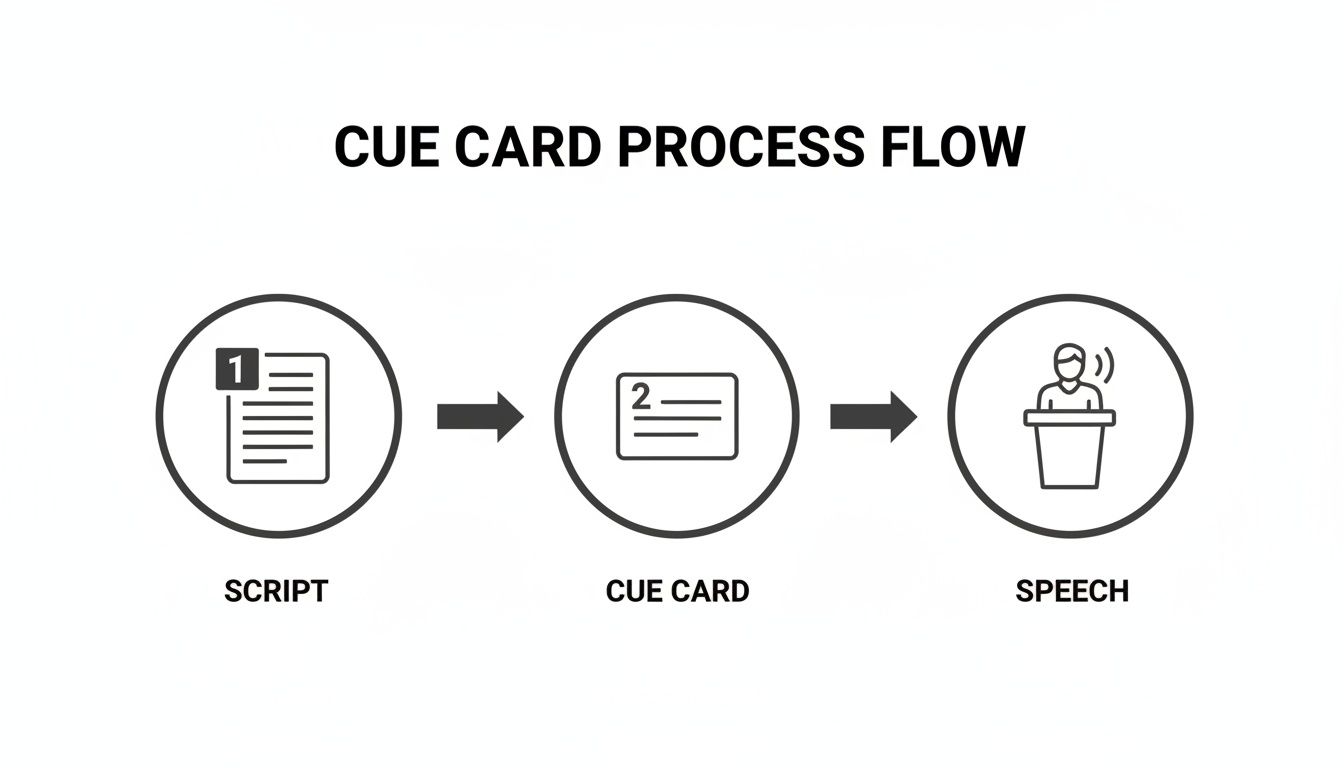
As you can see, cue cards are the essential bridge from the page to the podium. They distill your ideas, making your performance feel natural.
Embrace Imperfection to Create a Perfect Moment
Let’s be real for a second. The pressure to be perfect can be paralyzing. You start picturing yourself forgetting a key line or completely losing your place, and the anxiety just spirals. Cue cards completely dismantle that fear. They give you permission to be human and focus on what actually matters: the emotion and meaning behind your words.
Having that backup in your hand does a few amazing things for you:
- It skyrockets your confidence. Just knowing the prompts are there if you need them gets rid of that "what if I go blank?" panic.
- It promotes genuine eye contact. When you're only glancing at brief notes, you can spend most of your time looking at the happy couple and the guests, forging a real connection.
- It naturally improves your pacing. The simple action of finishing one card and moving to the next creates a natural pause. This keeps you from talking too fast and rushing your delivery.
At the end of the day, cue cards serve you, not the other way around. They empower you to be present in the moment and speak from the heart, delivering a message that everyone will remember for its warmth and sincerity—not for its flawless memorization.
What to Write on Your Cue Cards for Maximum Impact
The absolute biggest mistake you can make with cue cards is writing out your entire speech. The moment you do that, you stop giving a heartfelt toast and start giving a formal reading. It completely kills the vibe and severs your connection with the room.
Think of your cards as a safety net, not a script. They're your trusty map, designed to guide you from one great story to the next without getting lost.
From Full Script to Powerful Prompts
Your real goal here is to boil your speech down into a few powerful, bite-sized prompts. These are just memory triggers—a few key phrases, a single word, or an inside joke that instantly brings an entire section of your speech flooding back. This is the secret to maintaining that all-important eye contact, which makes the whole moment feel personal and real.
The process is much simpler than it sounds. Once you have a draft you're happy with, just go through it and pull out the absolute essentials.
For example, if you’re the best man, a prompt like “college pasta diet” is a thousand times better than a full paragraph about your university shenanigans. It’s a simple keyword that unlocks the memory and the story you want to tell.
Or, if you're the mother of the bride, a simple phrase like “first ballet recital” is all you need. That little note is packed with enough emotion to guide your words without forcing you to read a stilted, pre-written sentence. This is what keeps your delivery conversational and lets your genuine feelings shine through.
This approach is especially critical when you consider the pressure of the moment. Public speaking is a huge fear for many, and wedding toasts rank as a top stressor for over 25% of the wedding party. Having a clear, simple map in your hand is an incredible pressure-reliever. If you're curious about what makes these moments so significant, you can explore more insights about modern wedding trends.
Cue Card Content Do's and Don'ts
To help you decide what should make the final cut for your cards, here's a quick reference guide. Sticking to these simple rules is the key to a natural, engaging delivery that feels like you're just sharing a great story with friends.
| Do Include (The Essentials) | Don't Include (The Pitfalls) |
|---|---|
| Single keywords or short phrases | Full paragraphs or complex sentences |
| Names of people you want to thank | Every single word you plan to say |
| The punchline of a joke | Small, hard-to-read text |
| Action cues like (PAUSE) or (TOAST) | Vague prompts that could be confusing |
Remember, the best cue cards give you just enough information to feel secure, but not so much that you're tempted to read. Your eyes should be on the couple and the guests, not glued to your notes.
If you’re having a tough time pulling out these core ideas, a tool like Wedding AI can be a massive help. It's built to structure your speech around key stories and anecdotes, which makes it much easier to identify these essential prompts. From there, you can create a perfectly formatted document that's ready to be printed onto your cards.
Designing Cue Cards You Can Actually Read Under Pressure
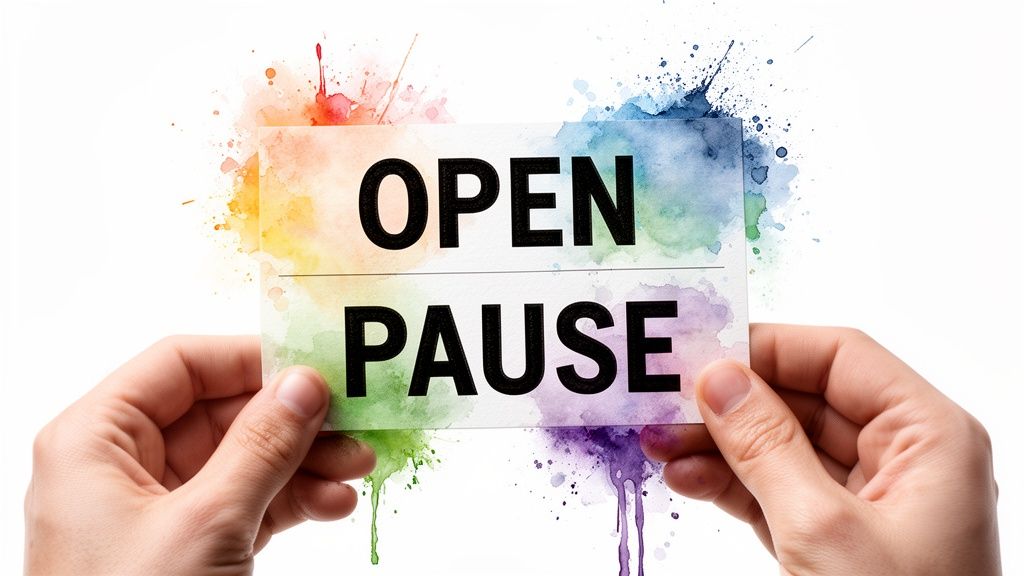
When the lights are on you and your heart is pounding, the last thing you want is to be squinting at a wall of tiny text. The physical design of your cue cards isn't just a minor detail; it’s the lifeline that can make or break your delivery. Think of them as a user-friendly interface for your brain when nerves kick in.
Your cue cards need to be instantly readable with just a quick glance. A shaky hand and a dimly lit reception hall are a terrible combination for small fonts or crowded lines.
Creating Visual Clarity
The whole point is to design something so clear you could read it from arm's length without a second thought. This is all about prioritizing legibility over cramming in every single word.
Here are the non-negotiables I always recommend for designing readable cue cards:
- Font Size: Go big. I’m talking a minimum of 16-point font, but don't be shy about bumping it up even more. The easier it is to see, the better.
- Line Spacing: Always double-space your lines. That extra white space is your best friend—it stops the text from blurring together and helps you find your place in an instant.
- Card Stock: Use thick, sturdy notecards. Standard 4x6 or 5x7-inch cards are perfect. Flimsy printer paper will tremble right along with your hand and can even rustle annoyingly near the microphone.
- Limit Your Points: Keep it simple. Stick to just 3-5 key points or prompts per card. Any more than that, and you’re basically back to reading a script.
Picture yourself standing at the mic during a wedding reception, with a hundred pairs of eyes on you. Speeches are an emotional high point, and public speaking anxiety affects about 75% of people. But I've seen firsthand how speakers who use well-designed cue cards can dramatically reduce their mistakes and feel so much more confident. If you're curious about other trends, you can find more global wedding insights here.
Using Formatting as Your Guide
Beyond the basics, you can use a few simple formatting tricks to act as visual signposts, guiding you through your speech without you even having to think about it. These little cues help your brain process information faster, freeing you up to focus on your delivery.
For example, using bold text for a transition word like "Next," or for the punchline of a joke, naturally draws your eye to the most important parts of the card. It's a simple way to remind yourself where you are and what's coming up.
Think of your cue cards less like a document and more like a dashboard. Every element should serve one purpose: to give you the right information at the right time, with minimal effort.
If designing and formatting feels like one more headache, a tool like Wedding AI can handle it for you. After you've polished your speech, it can generate a perfectly formatted PDF with large fonts and proper spacing, ready to print directly onto your notecards. This ensures your cue cards for speeches are built for performance right from the start.
Organizing Your Cards for a Foolproof Flow
You’ve put in the work. Your prompts are perfect, and your cards are clean and easy to read. But none of that matters if they get shuffled out of order right when your nerves are at their peak. A disorganized stack of cue cards is a small disaster just waiting to happen, but thankfully, the solution is beautifully simple.
Think of it as your best defense against fumbling. Even if you're feeling rock-solid confident, a moment of distraction or one clumsy move could send your perfectly timed speech flying. Taking a few extra minutes to secure your cards buys you an incredible amount of peace of mind.
Numbering: The Lifeline of Your Speech
First thing's first: number every single card. Don't skip this. Put a big, clear number in the top right-hand corner of each one. Trust me, these numbers are your ultimate lifeline.
If the unthinkable happens and you drop the whole stack on your way to the mic, those numbers will save you. You can reorder them in seconds. Without them? You'd be frantically trying to piece together a puzzle while a hundred people watch. It's a tiny action that eliminates a massive source of potential panic.
Keeping Your Cards Secure
With your cards numbered, your next step is to physically connect them. This is what keeps them from getting mixed up or, worse, one getting left behind on the table.
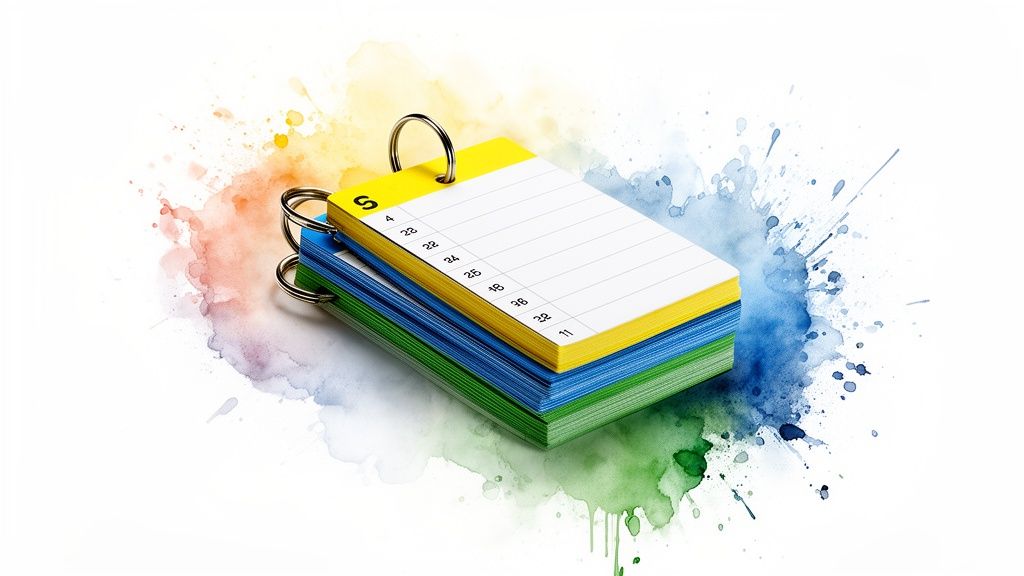
A single hole punch and a small binder ring are your best friends. Seriously. Just punch a hole in the top left corner of the stack and pop the ring through. This classic setup keeps everything in its place but still lets you flip from one card to the next without any friction. It’s a go-to method for a reason: it works.
Your goal is to eliminate every possible variable that could cause a slip-up. Securing your cards means you have one less thing to worry about, allowing you to focus completely on your delivery and connecting with the room.
Here's another practical tip: use a little bit of color-coding to mark out the different sections of your speech. A quick swipe of a highlighter creates a powerful visual cue that helps you track your progress without even thinking about it.
- Yellow for the opener: Maybe this is your ice-breaker joke or a short story about how you met the couple.
- Blue for the heartfelt middle: Use this for your direct message to the newlyweds.
- Green for the closing: This signals your final well-wishes and the big toast.
These colors act like little signposts, guiding you through the speech effortlessly. When you flip from a yellow card to a blue one, you'll instinctively know you're shifting gears into the emotional heart of your toast. This simple system ensures your cue cards for speeches become a seamless guide, not just a set of notes.
How to Rehearse With Your Cue Cards Effectively
You’ve got a perfectly formatted and organized stack of cue cards. Now comes the part that separates a good speech from a great one: your rehearsal. Let’s be clear, this isn't about memorizing every single word until you sound like a robot. The goal here is to build confidence and muscle memory so that when the moment arrives, your delivery feels completely natural.
To do this right, you need to practice like you'll perform. Find a spot where you can be alone, stand up, and hold your cards exactly as you plan to at the wedding. It sounds simple, but getting your body used to the physical act of giving the speech is a huge first step.
Simulate the Real Experience
Begin by reading your entire speech aloud a few times. This helps you find its natural rhythm and get a real feel for the timing. Once you're comfortable with the flow, put the full script away and rely only on your cue cards for speeches.
The technique you're aiming for is simple: glance down, get your prompt, and then look back up to deliver the line to your imaginary audience. This glance-and-speak method is the secret to a connected, engaging toast. It keeps your head up and your eyes on the happy couple and their guests, not glued to your notes.
Want to know the single best way to see what the audience will see? Record yourself on your phone. I know, it can feel a bit cringey, but trust me, it’s an absolute game-changer for spotting things you’d otherwise miss.
When you watch the playback, look for these things:
- Eye Contact: Are you genuinely connecting with the "room," or are your eyes darting back to the cards too often?
- Pacing: Does it sound like you're telling a heartfelt story, or are you just rushing to get through it?
- Card Handling: Is the transition from one card to the next smooth and unnoticeable, or is it awkward and distracting?
This is your chance to fine-tune everything. Maybe you realize you’re talking a mile a minute, or you find that one of your prompts isn't quite jogging your memory. No problem. Make the adjustment, take a breath, and record it again.
From Ancient Orators to Modern Weddings
Using prompts to deliver a powerful speech is hardly a new idea; you can trace it all the way back to ancient orators. But it’s found a new life at modern weddings, where technology is changing so much of the planning process. While couples use apps for everything from guest lists to vendor management, the speech itself often remains a tricky, manual task.
This is starting to change. As you can discover more insights about modern weddings on TheKnot.com, speakers are increasingly using digital tools to help them prepare, including easily printable cue card PDFs.
Practice isn’t about becoming perfect. It’s about building the confidence to be fully present and speak from the heart, knowing your cue cards are there as a safety net, not a script.
If you’re wrestling with the formatting and just want to get to the rehearsal part, a tool like Wedding AI can be a lifesaver. It lets you polish your speech and then instantly export a perfectly laid-out PDF, ready for you to print and practice with.
Don't Let These Common Cue Card Mistakes Trip You Up
You've put in the work—your speech is written, and your cue cards are ready. But even with perfect prep, a few common slip-ups on the day can derail your delivery. Let's cover the classic mistakes I see people make so you can walk up to that mic with total confidence.
The number one error? Hiding behind your cards. It's a security blanket, I get it. When the nerves kick in, your natural instinct is to lock your eyes onto your notes. But doing this completely severs your connection with the couple and their guests.
Instead, practice the glance, lift, and speak method. Glance down at your card just long enough to grab your next point. Lift your head and find a friendly face in the crowd (or look right at the newlyweds!). Then, and only then, deliver your line. It feels like a small thing, but it makes a world of difference.
The Little Details That Make a Huge Impact
Beyond how you hold them, a few seemingly minor details can cause major distractions. Think of this as your final pre-flight check—getting these things right lets you focus entirely on your words, not your props.
A classic mistake is printing on flimsy, standard-issue paper. That 8.5x11 sheet you grabbed from the office printer will visibly shake in your hand, and the rustling sound it makes near a hot microphone is incredibly distracting. Always, always print on thick, sturdy cardstock. It feels substantial and stays silent.
Your cue cards should be an invisible tool. The moment the audience notices the cards themselves—because they're rustling, or because you can't stop staring at them—they've stopped helping and started hurting your speech.
Another pitfall is trying to cram too much onto each card. People often write out long, winding sentences or try to set up an inside joke that takes a minute of explanation. Remember, if a joke requires a backstory, it's probably not going to land with a room full of people. Your prompts need to trigger clear, concise thoughts.
This is why you should never write your full speech out word-for-word on your cue cards for speeches. Stick to keywords and short, punchy bullet points. This forces you to speak from the heart, not read from a script, which is what makes a speech feel genuine and conversational. You'll sound like you're sharing a great memory, not reciting a document.
Answering Your Cue Card Questions
Even after you've got your speech down, a few questions about the logistics can pop up. Let's tackle some of the most common ones so you can walk up to that mic with total confidence.
Is It Really Okay to Use Cue Cards for a Wedding Speech?
Let me be crystal clear: absolutely, yes. In fact, I encourage it.
Walking up with cue cards doesn't look unprofessional; it shows you cared enough to prepare. Think about it. A father of the bride delivering a heartfelt, smooth toast from a few notes is far more impactful than someone trying to wing it and losing their train of thought. Your goal is connection, not a perfect memorization performance.
What About Just Using My Phone Instead of Cards?
I know it’s tempting to just pull up the notes app on your phone, but I strongly advise against it. Phones introduce too many variables you can't control.
The screen can be a nightmare to read in a dimly lit reception hall, and the bright glow often looks jarring in professional wedding photos. Even worse? An incoming call or a flurry of notifications buzzing in your hand can completely derail your focus. Stick with physical cards. They’re reliable, timeless, and keep you in the moment.
Your top priority is delivering your message with warmth and sincerity. Physical cue cards are a simple, elegant tool that helps you do just that, removing technological distractions so you can focus on the happy couple.
So, How Many Cue Cards Should I Actually Have?
For a standard 3-to-5-minute speech, which is typical for a maid of honor or best man, aim for 3 to 5 cards. This is a solid rule of thumb that keeps your notes from becoming a novel.
The trick is to think in terms of ideas, not a word-for-word script. Try dedicating one card to each key part of your speech:
- Card 1: Your introduction and how you know the couple.
- Card 2: A key story or heartfelt memory.
- Card 3: Your well-wishes and message to the newlyweds.
- Card 4: Your closing and the toast.
This approach transforms your cue cards from a crutch into an elegant guide, ensuring your speech flows naturally from one point to the next.
Crafting the perfect speech can feel like a lot of pressure, but you don't have to figure it out alone. Wedding AI is designed to help you weave your genuine memories into a beautiful, authentic toast that sounds just like you. Start writing your speech now at weddingai.com and get ready to deliver a moment they'll never forget.


