
Being asked to give a wedding speech is a profound honor. It’s a sign of deep trust and love, but let's be honest—it can also spark a healthy dose of fear. Public speaking is a challenge for many, but I want to let you in on a little secret: a great speech isn't about recounting a person's entire life story. It’s about sharing one good one.
All you need is a single, heartfelt story that reveals something true and beautiful about the couple. Your role isn't to perform; it's to create a moment.
Why Your Wedding Speech Matters More Than You Think
When you stand up to speak, you’re doing so much more than simply fulfilling a duty as the best man, maid of honor, or parent of the couple. You have the unique opportunity to publicly celebrate two people you adore on one of the most significant days of their lives. For those few minutes, you get to add a layer of personal history and emotion that makes the entire celebration richer for everyone.
Your words can draw out laughter, happy tears, and that wonderfully warm feeling that fills a room. Please, let go of any pressure to give a flawless, professional performance. What everyone will remember is the genuine emotion behind your words. Authenticity will always win.
Setting the Right Goal for Your Toast
Before you even think of writing a single word, let’s get your mindset right. Your goal is not to be the funniest person in the room or deliver a monologue that goes viral. It's much simpler, and far more meaningful.
You are there to accomplish three things:
- Make the couple feel cherished. Choose a story or an observation that puts a spotlight on their best qualities and why they are so perfect for each other.
- Bring the guests into the moment. Your story, while personal, should touch on a universal theme—love, friendship, finding your person—that resonates with everyone.
- End with a clear, heartfelt toast. The entire speech builds to this one final moment. It’s about raising your glass and inviting everyone to join you in wishing the couple a lifetime of happiness.
Think of your speech as a gift. As long as it comes from a place of sincerity and love, you truly cannot get it wrong. Your unique perspective is precisely what makes it special.
When you focus on these core goals, the pressure begins to melt away. You don’t have to be anyone but yourself. Whether you’re the father of the bride sharing a tender memory or the best man recounting a hilarious (but meaningful) adventure, your voice is exactly what the moment needs.
If you find yourself staring at a blank page, sometimes a gentle nudge can help. A tool like Wedding AI can be a wonderful starting point for brainstorming, asking questions designed to pull those perfect stories from your memories.
Finding Your Core Message and Gathering Stories
A truly great speech isn't something you simply sit down and write in one session. Think of it more like an archaeological dig—you need to sift through a lifetime of memories to find the gold. So, before you worry about the perfect opening line, your first task is to become a storyteller and let the memories surface.
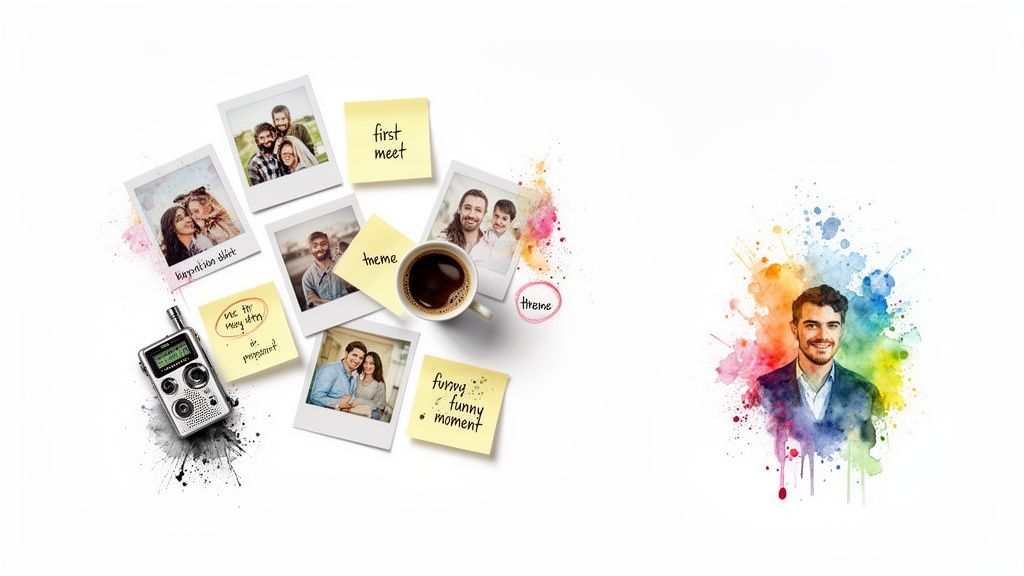
This brainstorming phase is where the real magic happens. Try not to filter yourself. Just let your mind wander. If you’re the best man, what was your honest first impression of the groom? Maid of honor, what went through your mind when your best friend first told you about their new partner? For a parent, was there a specific moment you knew your child had finally found the one?
Unearthing Your Best Anecdotes
Right now, your only job is to gather the raw materials. Don't stress about how the pieces will fit together yet. The key is to find anecdotes that show the couple’s best qualities rather than just listing them. Did their wonderful sense of humor get them through a stressful move? Is their generosity something you see in small, everyday actions?
Here are a few practical prompts to get you started:
- A defining moment: What’s one story that perfectly captures their personality?
- The "I knew it was real" moment: When did you first see them as a true, unbreakable team?
- A shared adventure: Can you recall a trip, a project, or even a funny disaster you all experienced together?
- An act of kindness: Think of a time they were there for you or someone else when it truly mattered.
Jot down everything that comes to mind, no matter how small it seems. The most powerful stories are often found in the simplest moments. If you feel stuck, a tool like Wedding AI can be a fantastic help. It asks targeted questions designed to jog your memory and unearth those perfect, half-forgotten details.
Discovering Your Central Theme
Once you have a list of memories, spread them out. As you read through them, look for a common thread. Is there a quality that keeps reappearing? This is your core message—the central idea that will weave your individual stories into a powerful, coherent narrative.
Perhaps the theme is their unwavering loyalty. Or maybe it’s their shared love of adventure, or the simple way they bring out the absolute best in one another. Identifying this theme is a crucial step in learning how to write a great wedding speech because it gives your toast a clear purpose. It becomes more than just a collection of random memories.
Your core message is the emotional anchor of your speech. It’s the single idea you want the couple and the guests to remember long after you’ve said, "Cheers."
For example, if you are the father of the bride, your stories might all point to the theme of her finding a partner who shares her compassionate spirit. Suddenly, your speech has a beautiful, heartfelt focus.
A Quick Guide to Speech Etiquette
As you gather stories, it’s the perfect time to set some ground rules for yourself. A great speech is remembered for all the right reasons. Keeping a few key principles in mind from the start will ensure your toast is a highlight of the day, not a moment everyone tries to forget.
Wedding Speech Do's and Don'ts
Consider this your friendly guide to keeping your speech on the right track.
| Do | Don't |
|---|---|
| Keep it between 3-5 minutes. | Ramble on for more than 7 minutes. |
| Tell a personal, heartfelt story. | Rely on inside jokes the audience won't get. |
| Focus on the couple. | Make the speech about yourself. |
| Practice out loud multiple times. | Read directly from your phone. |
| End with a clear toast to the newlyweds. | Use embarrassing or inappropriate stories. |
These aren't meant to restrict you, but to guide you. Think of them as the guardrails that keep your speech from going off course, ensuring it lands with warmth, sincerity, and class. With your best stories collected and your core message in mind, you're ready to start shaping them into something unforgettable.
Giving Your Speech a Winning Structure
You’ve gathered your best stories and memories. Now, how do you arrange them to create the most impact? This is where structure comes in. Without a clear framework, even the most heartfelt anecdotes can feel random and disconnected.
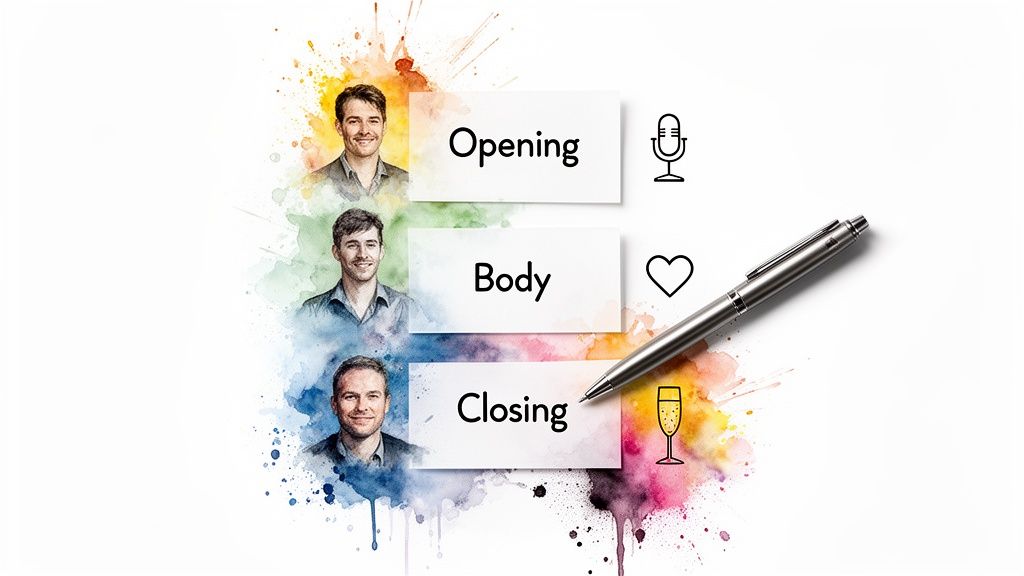
Think of it less as a rigid script and more as a simple roadmap for your audience. A good structure takes your listeners on a journey, building emotion and momentum until you reach a powerful conclusion. We’ll use the classic, time-tested three-part framework: the opening, the body, and the closing. It works because it’s the natural arc of any good story.
The Opening: Hook Them In
Your first 30 seconds are crucial. This is your chance to capture the room's attention, set the right tone, and let everyone know who you are. A simple, confident start is all you need.
First, introduce yourself and explain your connection to the couple. A maid of honor could begin with, "For those of you I haven't met, my name is Sarah, and I’ve had the joy of being Emily’s best friend since our days of building terrible forts in her backyard." This immediately gives your words weight.
Follow that with a quick, sincere welcome or a comment about the day. Something as simple as, "It's a genuine honor to celebrate two of my favorite people today," or "Looking around at all this love, it's easy to see how special you both are." This small touch creates an instant bond with the couple and the crowd.
The Body: Tell Your Story
This is the heart of your speech. It’s where you bring your core message to life. Your goal is not to list every memory you have, but to share one or two short, powerful stories that embody the theme you chose earlier. Remember, quality always trumps quantity.
A single, well-told story is far more moving than a dozen disconnected anecdotes. Whether you're a best man sharing a tale about the groom's unwavering loyalty or a parent recounting a moment that revealed your child's huge heart, ensure your story has a point. It should highlight a key quality in the person you're toasting and, ideally, connect it to their new partner.
The best stories show, they don't just tell. Instead of saying, "John is a generous guy," tell the story of the time he drove three hours in a storm to help you change a flat tire. That’s what people remember.
As you craft this section, keep your audience in mind. Inside jokes can leave most of the room feeling left out. Aim for stories that are personal yet tap into a universal feeling—friendship, finding your person, personal growth—so that everyone feels included in the moment. If your anecdotes feel a bit disjointed, a tool like Wedding AI can help weave them into a narrative that flows naturally.
The Closing: Bring It Home
You're in the home stretch. The closing is your chance to tie everything together and end on a high note. A great finish brings your speech full circle, offers a genuine wish for the future, and leads into a clear, confident toast.
Start by linking your story back to the present moment. You could say something like, "Seeing you two together today, it’s obvious that the same kindness you've always shown your friends has found its perfect home." This transition makes your speech feel intentional and complete.
Next, offer your heartfelt wishes for their marriage. Look directly at the couple and speak from the heart. Let your affection for them shine. A line like, "I wish you a lifetime filled with as much joy and laughter as you've brought into mine," feels personal and strikes the right emotional chord.
Finally, the toast itself. Make it a clear call to action. Raise your glass high and say something unambiguous like, "Now, would you all please join me in raising a glass to the newlyweds." It’s the perfect, celebratory end to a speech that came straight from your heart.
Writing Words That Sound Like You
When you stand up to give your speech, please remember this one thing: you're having a conversation, not reading an essay. Authenticity is what turns a decent toast into a moment people truly remember. Your most powerful tool is your own voice.
Let's focus on writing words that sound like they came from you. This isn’t about becoming a world-class orator overnight. It’s about being yourself.
Embrace Your Natural Tone
Think about how you talk to your friends. Are you naturally funny? Or are you more warm and sentimental? Whatever your style is, lean into it.
If you’re not a comedian, a wedding reception is not the place to test out a stand-up routine. Forced jokes land with a thud. On the other hand, if you're a heartfelt person, don’t be afraid to show it. A sincere, emotional speech will always connect more deeply than a slick, impersonal one.
Authenticity trumps eloquence every single time. Your speech is about your relationship with the couple, and your unique voice is what makes that relationship special. Don't try to be anyone else.
The easiest way to sound like yourself is to use simple, direct language. Resist the urge to use a thesaurus or construct complex sentences you’d never say in real life. You’re aiming for “trusted friend sharing a memory,” not “keynote speaker at a conference.”
A Game-Changing Trick for Finding Your Voice
Here is a simple, foolproof technique: read every draft out loud. I don't mean mumbling it under your breath. I mean actually speaking the words as if you were giving the speech.
Your ear will catch all the things your eyes miss:
- Clunky sentences that are too long or don't flow.
- Stuffy language that looks fine on the page but sounds robotic.
- Accidental tongue-twisters you didn’t realize you wrote.
As you read, ask yourself one simple question: "Would I actually say this to my friend?" If the answer is no, it’s time to rephrase. This one step is a game-changer for learning how to write a great wedding speech that truly connects.
Transcribe Yourself Talking
Still feeling a bit stuck? Try this practical tip. Take out your phone, hit record, and just tell one of your favorite stories about the couple. Don't script it. Just talk, as if you were telling it to another friend over coffee.
When you're done, play it back and type out what you said. You might be surprised. That transcript is pure gold—it’s filled with your natural cadence and your genuine emotion. This is the raw material, the most authentic version of your voice, which you can then polish into the core of your speech.
Finding Fresh Ways to Express Big Feelings
It’s easy to fall back on clichés when we’re trying to express love or happiness. But the best speeches find unique ways to say “I’m so happy for you” without using those exact words. The secret is to connect the feeling to a specific action or quality.
Look at the difference:
Instead of: "Sarah is such a kind person."
Try: "I’ll never forget how Sarah dropped everything to help me move, spending her whole Saturday lifting boxes, just because she's that kind of friend."
Instead of: "They are a perfect match."
Try: "When I see how he calms her down and how she makes him laugh, it's clear they found the missing piece of themselves in each other."
This simple shift grounds your emotions in real-life examples, making them feel so much more tangible and sincere. If you’re struggling to find the right words, a tool like Wedding AI can be a helpful brainstorming partner. It can suggest different ways to phrase a sentiment until it feels sophisticated, yet completely you.
Polishing and Practicing Your Delivery
You've written the speech. Congratulations, the hardest part is officially behind you. But the words on the page are only half the battle. Now it’s time to prepare for the delivery—the moment you stand up and share your story. A confident delivery can turn a good speech into an unforgettable one, and the secret is simply practice.
This isn’t about memorizing every word until you sound robotic. The real goal is to become so comfortable with your message that you can deliver it with genuine warmth, making eye contact with the couple and their guests instead of staring at your notes. You want to internalize the flow, not just the text.
From Rehearsal to Reality
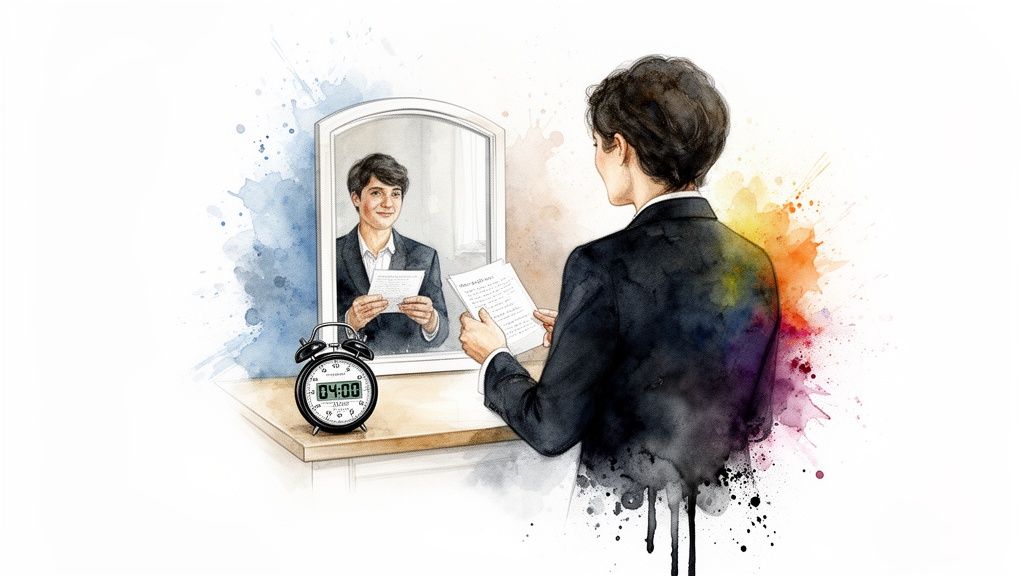
Your first step is to read your speech out loud. You will almost certainly stumble over a few phrases that looked great on paper but sound clunky when spoken. This is exactly what this stage is for. Each time you read through it, you’ll smooth out those rough edges.
Once you feel more comfortable, start timing yourself. You’re aiming for that 3 to 5-minute sweet spot. Anything longer, and you risk losing the room's attention. As wedding planner Jove Meyer notes, marathon formalities like "too many speeches" are on their way out. Guests appreciate brevity. Keeping your speech concise is a sign of respect for everyone's time. You can read more on evolving wedding traditions in this insightful Los Angeles Times feature.
The point of practice isn't perfection; it's confidence. The more you rehearse, the more the speech becomes a part of you, which lets your real personality shine through when it counts.
After you have the timing down, record yourself on your phone. I know it can feel a little strange, but listening back is one of the most valuable things you can do. You'll hear exactly where you start to rush, where you sound unsure, or where a joke could land with a bit more punch.
Preparing Your Notes and Yourself
Even the most seasoned speakers use notes, but the key is how you use them. I suggest you ditch the full script. Instead, use a few simple, elegant notecards and jot down just a few bullet points on each one. This gives you a safety net while encouraging you to speak more naturally from the heart.
To make your notes work even harder for you, mark them up with delivery cues:
- Highlight a few key words you really want to emphasize.
- Write "PAUSE" after a funny or emotional line to let the moment sink in.
- Add reminders like "SMILE" or "LOOK AT COUPLE" to ensure you’re connecting with the most important people in the room.
On the day of the wedding, your nerves will likely be firing. That's a good thing—it means you care. Before your name is called, try a few simple tricks to calm yourself. Take some slow, deep breaths. Squeeze and release your hands a few times to burn off that extra adrenaline. And remember, every single person in that room is rooting for you.
Mastering the Mic and Handling Emotions
The microphone is your friend. It's there so you don't have to shout. When you get up there, hold it a few inches from your mouth and just speak in your normal, clear voice. If it sounds too loud or quiet, don’t be afraid to adjust it. A quick, friendly "Can everyone hear me okay?" works wonders.
So, what happens if you get choked up? Let it happen. A few tears during a father-of-the-bride toast or a maid of honor’s speech are not a sign of weakness; they're a sign of love. If you feel your voice start to crack, just take a slow breath, have a sip of water, and smile. The room will wait for you. That moment of genuine vulnerability will often make your speech even more powerful.
Common Wedding Speech Questions Answered
Even after you've written what feels like the perfect speech, some last-minute jitters and practical questions always seem to pop up. Don't worry, that's completely normal. Let's walk through a few of the most common queries so you can step up to the mic feeling totally prepared and confident.
How Long Should a Wedding Speech Be?
The golden rule is to keep it between 3 and 5 minutes. That’s the sweet spot. It’s just enough time to tell a great story, share some heartfelt words, and toast the couple without losing anyone's attention.
If you're wondering how many words that is, it's roughly 400-750 words for someone speaking at a comfortable, natural pace. But don't get too hung up on the word count. The only way to know for sure is to time yourself. Just pull out your phone's stopwatch and do a practice run. It’s the best way to find out if you need to trim a little or add a bit more.
Should I Memorize My Speech or Use Notes?
I'm a huge advocate for a happy medium. Full memorization is a high-wire act; it can sound stiff, and if you forget one line, panic can derail the whole thing. On the other hand, reading directly from a piece of paper or your phone creates a barrier between you and the audience. You lose that crucial eye contact.
Your best bet is to become so familiar with your speech that you only need a few bullet points on a small notecard. Think of it as a safety net, not a script. This approach lets you speak genuinely from the heart, making eye contact and connecting with the room.
What Topics Should I Absolutely Avoid?
Your mission is to keep it positive. This is a celebration, a high point in your friends' or family's lives, and your job is to add to that joy.
With that in mind, here are a few things to steer clear of:
- Past relationships: Never, ever mention an ex. It’s an instant record-scratch moment that makes everyone uncomfortable.
- Truly embarrassing stories: What you find hilarious might be deeply mortifying for them in front of their grandmother. When in doubt, leave it out.
- Inside jokes: If only two other people are going to get it, you'll leave the other 100 guests feeling confused and excluded.
- Cynicism about marriage: Jokes about the "ball and chain" are tired and have no place here. Stick to celebrating their union.
What Is the Best Way to Start and End?
A memorable speech is framed by a strong opening and a clean, confident closing.
To start, always introduce yourself and explain your connection to the couple. For example: "Hi everyone, for those I haven't met, I'm Sarah, and I've had the privilege of being the bride's best friend since we were building forts in her backyard." It immediately gives everyone context.
As for the ending, don't let it just trail off. End with a clear toast. After your final wishes for the couple, raise your glass high and give a simple call to action. A classic line like, "So, would you all please join me in raising a glass to the happy couple!" is the perfect, timeless way to wrap it up.
Feeling ready to turn your memories into an unforgettable toast? Wedding AI guides you with smart, role-specific questions to help you unearth your best stories and crafts them into a speech that sounds completely, authentically you. Get your perfect speech in minutes at https://weddingai.com.


