
The secret to writing a great wedding toast is simpler than you think. It comes down to a warm opening, a personal story, and a heartfelt closing. The real key, however, is building your entire 3-5 minute speech around one specific, meaningful anecdote. Don't just list compliments. This one small shift is what will make your toast feel personal, authentic, and truly unforgettable.
Crafting a Modern and Memorable Wedding Toast
Being asked to give a wedding toast is an incredible honor, whether you are the best man, maid of honor, or a parent of the happy couple. It means you hold a special place in their lives. But let's be honest—that honor comes with a healthy dose of pressure. Your goal isn't just to string a few nice words together; it's to create a moment that genuinely adds to the magic of the day.
The good news is that the old, stuffy rules of wedding speeches are long gone. Today, what guests and the couple really want to hear is authenticity. Think of your toast as a gift you're giving them, and the best gifts always come from the heart.
The New Rules of Engagement
Modern wedding toasts are all about connection, not formal pronouncements. Guests want to hear a story that reveals something true and beautiful about the people they are there to celebrate. This is your chance to share your unique perspective on one of the newlyweds or what makes their bond so special.
This shift toward personal storytelling has changed the game. In fact, Zola's 2025 First Look Report found that 74% of couples think it's perfectly fine to use technology to help write a toast, as long as the core stories come from a real, personal place. It’s a perfect blend of modern tools and timeless tradition, all aimed at nailing that one perfect moment.
Your goal isn't to be the wittiest person in the room or a world-class orator. It's simply to share a piece of your heart and make the couple feel celebrated, loved, and seen.
Why Every Second Counts
With weddings now averaging 131 guests, you're speaking to a larger and more diverse crowd than ever before. Holding their attention is everything. This is precisely why the 3-5 minute timeframe is so critical—it’s long enough to tell a compelling story but short enough to keep everyone engaged.
Wedding planners have seen it all, and they report that speeches rambling past the five-minute mark are a major source of guest complaints. You can dig into more of these insights in The Knot's recent wedding study.
To keep your toast tight and impactful, it helps to understand the basic structure.
The Anatomy of a Perfect 3-5 Minute Toast
This table breaks down the essential structure and timing for a memorable wedding toast, ensuring you hit all the key points without losing the audience's attention.
| Section | Purpose | Ideal Time |
|---|---|---|
| The Hook | Grab everyone's attention, introduce yourself, and state your connection to the couple. | 30 seconds |
| The Story | Share one specific, meaningful anecdote that reveals a key quality of the person or couple. | 2–3 minutes |
| The Pivot | Connect your story back to the couple's relationship and their big day. | 30 seconds |
| The Toast | Raise your glass, offer well wishes, and lead the guests in a cheer. | 30 seconds |
This structure is a lifesaver. It keeps you on track and ensures your message lands perfectly.
If you’re feeling the pressure to fit your memories into this structure, tools like Wedding AI can help you shape your personal stories into a concise, impactful draft. It helps you hit all the right notes without any risk of rambling.
Ultimately, knowing how to write a wedding toast is less about a rigid template and more about understanding what works for a modern audience. Just focus on one great story, keep it concise, and speak from the heart. If you can do that, you'll create a moment the couple will cherish forever.
Finding the Story at the Heart of Your Speech
Every truly memorable wedding toast is built on a great story. It's the difference between a nice, polite speech and one that people are still talking about after the last dance. So, right now, I want you to shift your thinking from "What should I say?" to "What story can I tell?"
The best part? You already have everything you need. Your unique relationship with the person you're toasting is your superpower. As the best man, maid of honor, or parent, you’re sitting on a goldmine of memories no one else has. Your job is to sift through that history and find one perfect gem that captures who they are.
How to Unearth Your Core Story
First things first, let's do some memory mining. Grab a pen and paper (or open a new document) and just let the ideas flow. Don't censor yourself or worry about how it will sound just yet. This is about gathering the raw material.
Here are a few practical prompts to get you started, based on your role:
- For the Maid of Honor: Think back to a time you saw your friend truly happy before she met her partner. How did that happiness change or deepen once they were together? Or, remember a tough time you helped her through—what did that moment reveal about her character?
- For the Best Man: Can you pinpoint the exact moment you knew your friend had found "the one"? It might not be a grand declaration. Maybe it was a subtle change in his demeanor, the way he looked at his partner, or something he said that just clicked.
- For a Parent: Is there a childhood memory that perfectly illustrates the person they’ve become today? Think about a quality you always admired in them growing up—their kindness, their goofy sense of humor, their determination—and find a short, sweet story that puts that quality on display.
Try to jot down at least five distinct memories. Having options is key. If you find yourself staring at a blank page, a tool like Wedding AI can be surprisingly helpful for digging a little deeper with more specific questions to jog your memory.
Selecting the Winning Anecdote
Okay, you should now have a short list of potential stories. It's time to pick the winner. A great wedding story isn't just a random memory; it's an engine. It’s what will drive your entire toast forward and give it a real emotional punch at the end.
As you look over your list, search for a story that reveals a core, positive quality about the person you're honoring. Even better if you can cleverly connect that quality to their partner or their relationship as a whole.
A truly great wedding toast anecdote answers the silent question in every guest's mind: "Tell me something I don't know that will make me love this couple even more."
For example, a best man could tell a funny story about how his friend used to be hopelessly indecisive. Then, he can pivot to the absolute, rock-solid certainty he had about his partner from the moment they met. That contrast paints a powerful picture.
As you narrow it down, put your final choice to the test with these three practical questions:
- Is it inclusive? Steer clear of inside jokes. The story needs to land with everyone, from their college buddies to their great-aunt Susan.
- Is it positive and brief? This is a celebration, not a roast. The story should be uplifting and tight—you should be able to tell it in under two minutes.
- Does it feel like you? Pick the story you are genuinely excited to share. Your authentic connection to the memory is what will make the delivery feel heartfelt.
Nailing this one, perfect story is the single most important step. It’s the foundation for a toast that isn’t just well-written, but deeply moving and uniquely yours.
Giving Your Toast the Right Shape
Okay, you've found a fantastic story. Now what? You need to build a frame for it. Without a solid structure, even the most heartfelt memory can get lost or feel jumbled. Think of it this way: a good structure takes your audience on a journey, making your message stick long after the champagne flutes are empty.
Your goal isn't just a simple beginning, middle, and end. You're aiming for a framework that builds momentum and lands with a powerful, emotional punch. Getting this right is what makes a toast flow beautifully from your introduction to that final "cheers!"
Picking a Narrative Framework
Every great story has a shape. For a wedding toast, you don't need a complex plot. You just need a clear path that’s easy for everyone to follow. The best toasts almost always use one of two simple, yet incredibly effective, frameworks. These work whether you're a best man recalling a wild college trip or a parent sharing a sweet childhood memory.
This little diagram breaks down how you can turn a single memory into a complete toast.
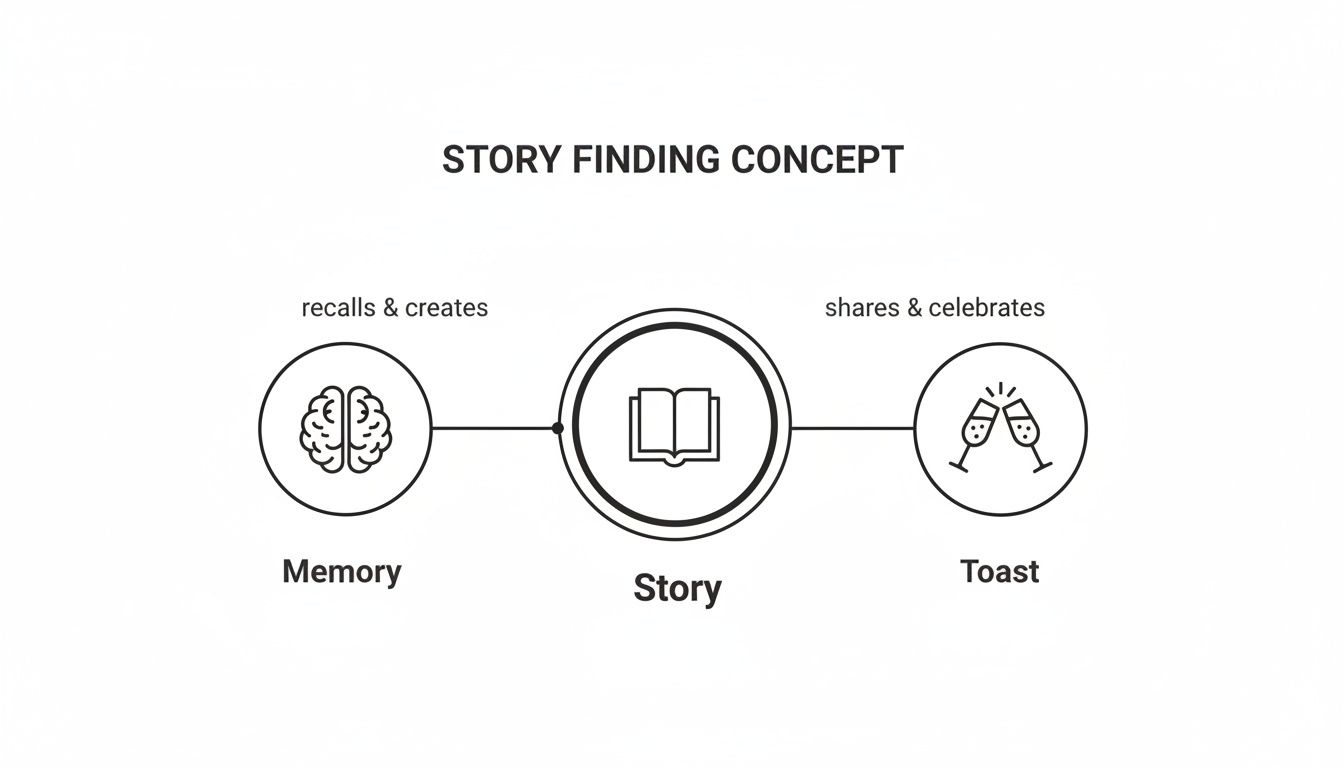
It’s all about unearthing a great memory, shaping it into a story, and delivering it as a celebration.
The Then and Now Framework
This is a classic for a reason—it’s powerful because it shows growth and transformation. You start with a memory from the past ("Then") and connect it directly to this moment ("Now"). This contrast is brilliant for showing the amazing impact the new spouse has had.
- Then: Start with a story about your friend's life before they met their partner. A maid of honor, for example, might recall her friend’s hilariously disastrous dating phase. The idea is to paint a quick, vivid picture of who they were.
- Now: Then, you pivot to the present. You describe how meeting their partner changed everything for the better. Maybe they found balance, learned to be vulnerable, or discovered a new level of happiness. The contrast is what gives the story its emotional kick.
Here's how it sounds: "I remember back in college, Liam practically lived in the library. He was brilliant, but so serious. And now, seeing him with Chloe, I see that same brilliance, but it’s mixed with this incredible lightness and joy. Chloe, you’ve brought out a side of him that just makes him whole."
The Single-Theme Structure
This approach is pure elegance. You pick one single, defining quality—like kindness, courage, or an adventurous spirit—and build your entire speech around it with a quick anecdote. It's incredibly effective because it leaves the audience with one strong, positive takeaway.
Imagine you're the father of the bride and your theme is "generosity."
- The Anecdote: You could share a quick memory of her as a little girl, perhaps how she always shared her favorite toy without being asked.
- The Connection: Then, you tie this lifelong generosity to her new marriage, saying you know she’ll bring that same giving spirit to her partnership.
This structure isn't about a timeline; it’s about illustrating a fundamental truth about who they are.
Building Your Toast, Piece by Piece
No matter which framework you choose, every great toast has four key parts. The magic is in the transitions—making them feel smooth is what separates a good speech from a great one.
- The Opening Hook: Get right to it. Introduce yourself and your connection to the couple. "For those of you who don't know me, I'm Sarah, and I've had the honor of being the bride’s best friend since we were five."
- The Core Story: This is where you deliver your "Then and Now" or "Single-Theme" story. Keep it tight! You're aiming for 90 seconds to two minutes, max.
- The Pivot to the Couple: This is a crucial turn. You have to explicitly connect your story about one person to both of them. For instance, "That same loyalty I saw on the football field is what I now see in the way he looks after you, Jessica."
- The Closing Toast: The grand finale. Raise your glass, address the couple directly, offer your genuine wishes for their future, and invite everyone to join you. "So let's all raise a glass to the happy couple. To a lifetime of love, laughter, and adventure. Cheers!"
By focusing on a strong structure, you're making sure your words become a truly cherished part of the celebration.
Writing and Refining Your Words
Alright, you have your story and a solid structure. Now for the fun part: turning those bullet points and memories into an actual toast. This is where your ideas find their voice.
The single most important piece of advice I can give you is this: write like you talk.
Read every sentence out loud as you type it. Does it sound like you? Or does it sound like you’re reading from a greeting card? If it feels stiff or too formal, rewrite it. Imagine you’re telling this story to a good friend over coffee—that’s the tone you’re aiming for.
Write for the Ears, Not the Eyes
Remember, you're not writing an essay for an English teacher. You're writing a script to be performed. This means your words need to land well when spoken, which is completely different from writing for a reader.
Lean into shorter sentences and simpler language. What looks elegant on a page can sound like a mouthful when you're standing in front of 100 people. Your goal is for people to feel the emotion, not to get tripped up by complex vocabulary. Clarity and warmth are your best friends here.
Your toast is a gift of words, not a demonstration of your writing prowess. The best speeches are the ones where the words disappear, and all the audience feels is the emotion behind them.
This is also a great time to get a second opinion. If you're finding it tough to translate your memories into spoken words, a tool like Wedding AI can be surprisingly helpful. It's designed to take your raw stories and help you polish them into a draft that sounds like a better, more prepared version of you.
Sidestep These Common Writing Traps
As you get into the flow of writing, it’s easy to stumble into a few common pitfalls. Knowing what they are ahead of time will save you from some awkward moments and a lot of last-minute editing.
Keep your speech inclusive and celebratory by avoiding these classic toast-killers:
- The Inside Joke: A quick, knowing glance is fine. A five-minute story that only your college roommates will understand is not. It leaves every other guest feeling confused and left out. If a joke needs explaining, cut it.
- Embarrassing Stories: This is a toast, not a roast. While some gentle, affectionate ribbing can work wonders, stay far away from anything that could cause genuine humiliation. Your job is to make the couple shine.
- Mentioning Exes: This should be obvious, but you would be surprised. It's a hard and fast rule: no exes. It doesn't matter how funny the story is. It just makes the room uncomfortable. Period.
By keeping your stories positive and relatable, you make sure your toast is a moment of connection for everyone in the room.
Refresh Your Language and Ditch the Clichés
Nothing tanks a heartfelt speech faster than a parade of tired clichés. We all reach for them because they’re easy, but they have been used so often they've lost all meaning. You can do better.
A personal, specific compliment will always land with more impact than a generic phrase. Scan your first draft and hunt down any of these usual suspects.
Here’s a practical guide to swapping out the cliché for something with more heart:
| Instead of This Cliché... | Try This Specific Alternative... |
|---|---|
| "A match made in heaven." | "You two just make sense together in a way that’s hard to explain but beautiful to see." |
| "They complete each other." | "I love how you bring out the absolute best in each other. It’s been incredible to watch." |
| "Two become one." | "Your partnership is a brand new adventure, and I can't wait to see where life takes you both." |
| "My partner in crime." | "My go-to person for everything from late-night talks to questionable karaoke." |
Don't just say they're a perfect match; show us how. Specificity is the antidote to cliché and the secret ingredient to a truly memorable toast.
Preparing for Delivery and Owning the Moment

You’ve wrestled with words, found that perfect story, and polished your toast until it shines. Now comes the part that makes most people nervous: actually delivering it. The truth is, a great toast is only half writing. The other half is delivering it with the warmth and confidence it deserves.
This isn’t about becoming a world-class orator overnight. Forget perfection. The real goal is to get comfortable enough to let your genuine affection for the couple connect with everyone in the room. Think of it less as a "performance" and more as sharing a great story with a room full of friends.
Practice with Purpose, Not for Perfection
Let's get one thing straight: practice isn't about memorizing every single word. That’s a trap. Trying to nail it word-for-word is a surefire way to sound stiff and robotic.
Your real goal is to internalize the flow of your speech. Read it out loud a few times, focusing on the main beats of your story and how you move from one idea to the next. You want to know it well enough that you can look up from your notes, make eye contact, and really connect with the couple.
The most memorable toasts feel natural and spontaneous, even when they've been carefully prepared. Practice should build your confidence, not your anxiety about hitting every line perfectly.
Here’s an actionable tip: record yourself on your phone. It feels a little strange at first, but listening back is the single best way to catch where you’re rushing or where a sentence doesn’t land right. It helps you tweak your delivery in a way that just reading it in your head never will.
Mastering Your Pacing and the Power of the Pause
Nerves make us talk fast. It’s just human nature. One of the most effective things you can do is to consciously slow yourself down. A calm, measured pace projects confidence and, more importantly, gives your words space to sink in.
Just as crucial is the strategic pause. A brief moment of silence right before a heartfelt memory is pure gold. It builds anticipation and gives your words so much more impact.
- Pacing Tip: Time yourself. If your 400-word speech is clocking in under three minutes, you are probably rushing. Aim for a comfortable, conversational speed.
- Pause for Effect: Take one deliberate breath right before you raise your glass for the final toast. That tiny pause signals to everyone that the big moment has arrived.
By managing your rhythm, you’re not just speaking—you’re guiding the room on an emotional journey.
Calming Your Nerves Before You Speak
Okay, let's talk about public speaking anxiety. Even seasoned speakers feel those butterflies. The secret isn't to crush your nerves, but to manage them so they don't hijack the moment.
Your mindset is everything. Remember why you were asked to do this in the first place—you mean something special to this couple. The audience isn't a panel of judges; they are on your side, ready to celebrate with you.
Just before you’re called up, try this simple breathing trick. Inhale slowly for four seconds, hold for four, and then exhale for six. Do that a few times. It’s a surprisingly effective way to tell your nervous system to calm down.
The Great Debate: Notes or No Notes?
There is absolutely no shame in using notes. In fact, it's the smart move. Going completely off-script is a high-wire act that often ends in a jumbled mess. The real question is how to use your notes effectively.
- Notecards: Small, discreet notecards are the gold standard for a reason. Jot down bullet points or just the first few words of each paragraph. This is all you need to jog your memory without being tempted to read from a script.
- Your Phone: It's acceptable to use a phone, but it has its pitfalls. The screen's glow can be distracting, and notifications are your enemy. If you go this route, bump up the font size, activate "Do Not Disturb," and lock the screen orientation.
Whatever you choose, hold them at a natural height. You want to be able to glance down quickly without breaking eye contact for too long. Your notes are a safety net, not a script. They're there to support you while you deliver a toast that feels present, connected, and completely in the moment.
Answering Your Final Wedding Toast Questions
You've found the perfect story and mapped out your speech. But as the wedding day approaches, a few last-minute questions always seem to surface. It’s completely normal. Let’s walk through some of the most common ones we hear from everyone, from the best man sweating in the corner to the mother of the bride.
Think of this as our final chat to smooth out the details, so when you step up to that microphone, you’ll feel nothing but confidence.
How Long Should a Wedding Toast Be, Really?
Aim for the three-to-five-minute sweet spot. This is the golden rule. It’s just enough time to introduce yourself, share a great little story, and wish the couple well without seeing guests start to shift in their seats.
When you practice, actually time yourself. A three-minute toast clocks in at around 350-450 words spoken at a natural pace. Anything less can feel rushed. Go beyond five minutes, and you risk losing the room's energy right when dinner or dancing is about to kick off.
What Topics Are Completely Off-Limits?
A great toast is celebratory and makes everyone feel good. To make sure yours lands perfectly, there are a few topics you should avoid at all costs. These are non-negotiable.
Here's your "never, ever mention" list:
- Past Relationships: This is the big one. Do not mention exes. Not as a joke, not as a comparison, not ever. It’s instantly awkward for the couple and every single guest.
- Inside Jokes: If you have to start a story with, "You had to be there, but…," then it’s not the right story for the toast. You want the whole room to feel included, not just a few people who get the obscure reference.
- Embarrassing Stories or Money: A wedding isn't a roast. Keep any genuinely embarrassing stories for another time. The same goes for any comments about the cost of the wedding. Your job is to make the couple shine.
Your words are a gift to the couple. Make sure it's one they’ll be happy to receive in front of their friends, their new in-laws, and their grandma.
Is It Okay to Use Notes?
Yes, a thousand times, yes. Please use notes. Even seasoned public speakers use them. Trying to memorize a speech word-for-word is a recipe for sounding stiff and robotic, or worse, completely blanking out when nerves hit.
Think of your notes as a safety net, not a script. They're there to guide you, not to be read from. This frees you up to connect with the couple and the audience in a genuine way.
The trick is to use them correctly. A few small notecards with bullet points are your best friend. Just jot down the first few words of each paragraph or a handful of key phrases to jog your memory. This lets you look up, make eye contact, and deliver your toast with the warm, conversational feel you're going for.
How Can I Be Funny Without Telling Cheesy Jokes?
The best humor in a wedding toast isn't about punchlines; it's about affection. Forget trying to be a stand-up comedian. Instead, find the humor in a real, shared memory.
Think of a lighthearted story that highlights a charming or quirky trait of the person you're honoring. Maybe it’s about their terrible sense of direction or their obsession with a particular band. When the humor comes from a place of love and a genuine anecdote, the laughter it gets is real. It connects everyone in the room and feels far more meaningful than any pre-canned joke ever could.
Crafting a memorable toast is all about heart, but you don't have to go it alone. Wedding AI can be a fantastic partner in helping you brainstorm your best stories and structure them into a speech that’s both polished and deeply personal. Give it a try and transform your memories into a standout moment.
You can learn more and start writing at https://weddingai.com.


