The secret to a great wedding speech isn't finding the perfect joke or some profound quote you pulled from the internet. It's about figuring out the one core feeling you want to leave with the room. Before you even think about putting pen to paper, you need to set a clear intention.
Find Your Core Message Before You Write a Single Word
The pressure to be brilliant at the mic can feel overwhelming. You might be staring at a blank page, trying to cram years of friendship or family history into just a few minutes.
Here's the good news: you don't have to. Your only job is to be yourself and speak from the heart.
Think about your specific relationship with the person you’re celebrating. Are you the best man who wants to share a story that perfectly captures the groom's loyalty? Or perhaps you're the mother of the bride, and your true goal is to express an overwhelming sense of pride. Let that single emotion be your guide.
Start with a Feeling, Not a Formula
Instead of following a rigid template, ask yourself one simple question: What is the one thing I want everyone here to know or feel about this person or this couple?
Your answer is your north star. It’s the central theme that will hold your entire speech together, making the writing process so much simpler. You’re no longer hunting for generic wedding clichés; you’re digging for specific memories that bring your theme to life.
- For a Maid of Honor: Your core message could be the bride’s unwavering kindness. An actionable tip is to find one story about a time she dropped everything to be there for you, then tie it back to the kindness you see in her new partnership.
- For a Father of the Groom: Your theme might be pride. A practical approach is to share a quick memory from his childhood that hinted at his character, then connect it to the wonderful partner he has chosen.
The speeches that stick with people aren't the flashiest. They're the ones where the speaker's genuine affection is so obvious that everyone in the room can feel it. Your authenticity is your greatest asset.
This focus on a central feeling is more important than ever. Wedding experts note a trend toward creating "immersive guest experiences," and your toast helps tell the couple's story. With an average of 116-145 guests at a wedding, your words need to connect on a personal level. As 54% of couples incorporate technology into planning, a truly heartfelt, human moment stands out. You can dive deeper into these wedding trends and their impact on celebrations.
By starting with a core message, you build your speech on a foundation of genuine emotion. If you're having trouble turning that feeling into the right words, a tool like Wedding AI can help. It asks targeted questions to pull out those specific memories and shape them into a story that flows.
Crafting a Speech That Flows Beautifully
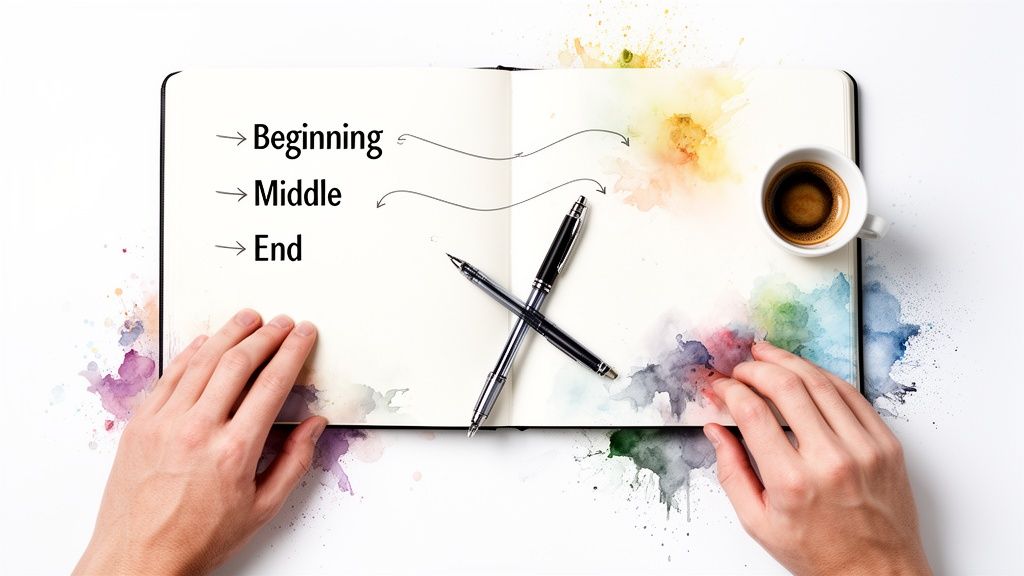
Every great story has a beginning, a middle, and an end. Your wedding speech is no different. Forget intimidating formulas; a simple three-act structure gives your toast a natural, polished flow that feels authentic, not memorized.
This approach gives you a clear roadmap for what to say, guiding the audience along so your message lands with warmth and sincerity.
The Opening Hook
You have about 30 seconds to grab everyone's attention. This is your moment to introduce yourself and explain your connection to the couple. Don't overthink it—be warm, confident, and direct.
If you're the best man, you could start with a lighthearted observation about the groom. If you're the mother of the bride, you might open by simply expressing the pure joy of the day. Your goal is to make everyone feel welcomed into your story.
- Actionable Tip: Introduce yourself clearly: "Good evening, everyone. For those I haven't met, my name is Alex, and I’m the groom’s older brother."
- State your connection: "Sarah and I have been best friends since we were navigating middle school together."
- Set the tone: Briefly express your happiness for the couple. This creates a perfect, smooth transition into the heart of your speech.
The Heart of Your Story
This is where you bring your core message to life. The biggest mistake you can make here is trying to tell the couple's entire life story. Instead, pick one or two specific, short anecdotes that show a quality you admire in them.
Think about small, meaningful moments. A story about their generosity, their loyalty, or the hilarious way they first met can be far more powerful than a long list of accomplishments.
A great story shows, it doesn’t just tell. Instead of saying your friend is kind, share a two-sentence memory of their kindness in action. That is what will resonate and stick with the guests.
This focus on personal connection matters. With wedding parties shrinking and fewer weddings sticking to traditional formats, speeches have become a prime opportunity for genuine connection. Modern trends show 36% of engaged couples are using AI for planning. A well-crafted, personal story will cut through the noise. You can discover more insights about how wedding celebrations are evolving.
The Memorable Close
Your closing is your chance to tie everything together. In the final 30-45 seconds, bring your speech back to the present moment—the wedding day itself.
Connect the theme of your story to the couple and their future. For example, if your story was about the bride's adventurous spirit, you can wish them a lifetime of grand adventures together.
Finally, offer your sincere well wishes and confidently raise your glass. This is the classic, powerful ending that signals it’s time to celebrate. A simple "To the happy couple!" is all you need.
For a quick reference, here’s a simple blueprint that breaks down how to structure your speech.
The Wedding Speech Blueprint
Use this quick reference to structure your speech for maximum impact and a natural flow.
| Speech Section | Your Goal | Example Snippet |
|---|---|---|
| The Opening | Grab attention, introduce yourself, and state your relationship to the couple. | "Hi everyone, I’m Maria, the maid of honor. I’ve known Chloe since we were five, and I couldn't be happier to be here today." |
| The Body | Share 1-2 short, personal anecdotes that highlight a positive quality. | "I'll never forget the time Mark drove three hours just to help me fix a flat tire. That’s the kind of loyalty he shows everyone he loves." |
| The Closing | Connect your story to the couple's future and propose a toast. | "Seeing that same loyalty between you two makes me so hopeful for your future. Now, let’s all raise a glass to Mark and Chloe!" |
This simple structure is your key to a speech that feels both organized and genuinely heartfelt. If you're struggling to find the perfect closing line, a tool like Wedding AI can help you generate options that feel true to your message.
Tailoring Your Toast to Your Role
Your relationship with the couple is your superpower. It gives you a unique perspective that no one else in the room has. Leaning into that is exactly what will make your speech land perfectly.
A best man’s toast hits differently than a father’s heartfelt blessing. Knowing what to say starts with understanding your role and the unique stories only you can tell. This isn't about following a script, but about using your vantage point to share something meaningful.
For the Maid of Honor
Think of your speech as a celebration of your friendship and the bride's personal journey. You’ve been there for so many chapters, and your toast is the perfect way to honor that evolution.
Focus on a single story that puts her best qualities on display—her resilience, kindness, or adventurous spirit. Then, connect that quality to the joy you see she’s found with her new partner. It’s not just a speech about your friend; it’s about why this new chapter makes perfect sense to the person who knows her best.
- Practical Tip: Think of a time she showed up for you during a tough time. How does that same loyalty shine through in her relationship now? Use that memory as your anchor.
For the Best Man
Your job is to walk that fine line between humor and heart. A funny story about the groom is often expected, but the goal is to make him look good, not leave him red-faced. The best anecdotes are lighthearted ones that reveal his true character.
Pick a memory that showcases his loyalty or his big heart, even if it’s wrapped in a hilarious situation. After you get a laugh, bring it back to a place of genuine sincerity. Talk about how you’ve seen him change for the better since meeting his partner and express your happiness for them both.
The perfect best man speech formula? Think 80% genuine admiration and 20% gentle roast. It should leave everyone, especially the couple, feeling warm and celebrated, not cringing.
For a Parent of the Couple
As a parent, your words carry a special weight. Your toast is a moment to publicly express your pride, share a memory only you have, and officially welcome your new son or daughter-in-law into the family.
Your perspective is uniquely poignant. You could share a brief, sweet story from their childhood that hinted at the person they would become. This creates a beautiful full-circle moment, connecting their past to this incredible new future. It’s your chance to offer a blessing and set a tone of love and acceptance.
This feels especially important as weddings evolve. Today, Gen Z represents 51% of couples getting married, and they’re often blending heritage with modern flair. Your words can honor that beautifully. And with 54% of couples now using AI to help plan their big day, a heartfelt, human touch from a parent stands out more than ever. You can learn more about how modern couples are planning their weddings in Zola's latest report.
For a Sibling or Other Close Loved One
As a sibling, you’re sitting on a goldmine of shared history. You can speak to the couple's bond from a place of deep, personal understanding. Go for a memory that highlights their character or a funny childhood quirk that the family will appreciate.
Your speech can be the perfect bridge between their family life and their new married life. If you feel stuck organizing a lifetime of memories, a service like Wedding AI can help structure those stories into a speech that feels both personal and polished.
Choosing Words That Connect and Resonate
The words you choose are what will make your speech unforgettable. This is your chance to move beyond ideas and find the language that makes every sentence feel genuine.
The aim is simple: express love, joy, and admiration without leaning on the same old wedding clichés. Instead of telling everyone the groom is generous, you're going to show them with a quick, vivid story of him in action.
Show, Don’t Tell
The most powerful speeches trade generic adjectives for specific stories. It’s the difference between saying, "Sarah is such a loyal friend," and sharing a two-sentence memory of a time she actually proved her loyalty.
This storytelling approach is what makes your message stick. It anchors your compliments in reality and gives the audience a reason to connect with what you’re saying.
As you start writing, here are a few common traps to sidestep:
- Alienating Inside Jokes: A quick, knowing glance is one thing, but a long story that only three people understand will leave everyone else feeling lost. Your job is to bring the room together.
- Mentions of Past Relationships: This is a hard-and-fast rule. Don't go there. The speech is about this couple and their future.
- Clichés and Vague Compliments: Phrases like "a match made in heaven" don't say anything personal. Your unique stories are what will make this toast special.
You are the keeper of memories that no one else has. Instead of borrowing from common wedding phrases, borrow from your own experiences with the couple. Your personal perspective is your most powerful tool.
Elevate Your Language with Intention
Figuring out what to say in a wedding speech is often a process of subtraction—cutting the words that don't add much to make room for the ones that truly matter.
For instance, you might be tempted to say, "I knew they were soulmates from the start." It’s a nice sentiment, but it’s not a story.
A much stronger way to say it would be: "I'll never forget the first time I saw them together. The way Mike looked at Emily while she was telling that ridiculous story about her cat... that’s when I knew this was different. He wasn't just listening; he was truly seeing her."
See the difference? That small shift takes a generic statement and turns it into a meaningful, visual moment for everyone.
If you find yourself stuck trying to turn a feeling into a story, a tool like Wedding AI can help. It asks you questions to pull out those specific, heartfelt details, making sure your speech is full of them. Your words should make the couple feel seen, celebrated, and deeply loved.
From Your Final Draft to a Confident Delivery
Getting the words on paper is a massive win, but how you deliver them is what truly makes them stick. Let's walk through how to take your final draft and turn it into a poised, heartfelt toast that connects with everyone.
Think of this as your pre-game warm-up. The goal isn't to become a professional orator overnight. It’s about feeling comfortable enough to let your genuine affection for the couple shine through.
Practice, Then Practice Some More
Reading your speech in your head isn't the same as saying it out loud. You need to hear it. The only way to get a real feel for the rhythm and flow is to practice it verbally, again and again.
A practical first step is to time yourself. The sweet spot for a wedding speech is 3 to 5 minutes. That's enough time to share something meaningful without losing the crowd's attention. If your first run clocks in at seven minutes, you know it's time to trim.
This is also your chance to catch any tongue-twisters or awkward phrases. Tweak them until they feel natural when spoken.
Master Your Pacing and Pauses
Nerves can make us talk too fast, turning our carefully crafted sentences into a jumble. Practicing aloud builds muscle memory for a calmer, more deliberate pace.
One of the most powerful tools you have is the pause. A short, intentional pause before a key message or after a punchline adds weight and emphasis. It lets the audience catch up and makes you look far more confident.
A well-timed pause isn’t a sign that you’ve forgotten your place. It's the mark of a confident speaker. It pulls the audience in and gives your best lines the space they need to truly land.
Owning It on the Day
When your name is called, a few simple techniques can help you manage nerves and connect with the room. Keep these pointers in mind:
- Make Real Eye Contact: Don't just sweep your gaze across the room. Find a few friendly faces, but most importantly, look at the couple. This speech is for them, and that connection will ground you.
- Find Your Stance: Stand with your feet planted about shoulder-width apart. A solid stance prevents nervous swaying and helps you feel more in control.
- Use Your Notes, Don't Read Them: Bringing notes is smart. Opt for small notecards with bullet points instead of a full script. This lets you glance down for a reminder without burying your face in a piece of paper.
If you’re having a tough time trimming your speech to that perfect length, a tool like Wedding AI can be a great help. Its features are designed to help you hit that ideal time, making sure your delivery is as polished as your writing.
Answering Your Last-Minute Wedding Speech Questions
You've written the speech and practiced it. It's normal for a few last-minute jitters or questions to pop into your head. Don't let them throw you off.
Let's quickly tackle some of the most common worries so you can walk up to that mic feeling cool, calm, and ready.
How Long Should My Wedding Speech Be?
Stick to the golden rule: 3 to 5 minutes. This is the sweet spot. It's just enough time to tell a great story and share your love, but short enough that you won’t see guests checking their phones.
When you practice, use your phone's stopwatch. If you're clocking in over five minutes, it’s time to be ruthless and trim a few lines. The goal is to leave them wanting more, not wondering when you're going to wrap it up.
Is It Okay to Use Notes During the Speech?
Not only is it okay, but I highly recommend it. Think of your notes as a safety net, not a script. They're there to ensure you hit all your key points without the fear of your mind going blank.
The secret is how you use them. A practical tip is to jot down a few bullet points on a small notecard. This setup lets you glance down for a quick reminder, freeing you up to make genuine eye contact with the couple and the audience.
Using notes isn't a crutch; it's a tool for confidence. A few keywords on a card can keep you grounded, allowing you to focus on your delivery and connecting with the room, rather than panicking about what comes next.
What if I Get Emotional While Speaking?
Let it happen. Getting emotional isn't a sign of weakness; it’s a sign of how much you genuinely care. Those authentic moments often make a speech truly unforgettable.
If you feel your voice start to crack, just pause. Take a deep, slow breath. Have a sip of water. The entire room is on your side and will give you the space you need. A little heartfelt emotion is powerful, so embrace it.
Can I Tell a Funny Story?
Absolutely, as long as you pick the right one. The best humorous stories are lighthearted, shared experiences that make the couple look good in a charming, lovable way.
Just be sure to follow a few hard-and-fast rules:
- No embarrassing tales. This is a toast, not a roast. You're aiming for a gentle chuckle, not a cringe.
- Steer clear of exes. Mentioning past relationships is the ultimate wedding speech faux pas. Just don't.
- Skip the inside jokes. If only you and two other people will get the punchline, save that story for another time.
Your humor should bring everyone in the room together for a shared laugh.
Putting the right words together is a huge accomplishment. If you need a little help turning those memories into a speech that shines, Wedding AI can guide you through the process. We'll help you craft a toast that sounds completely, authentically you. Find out more at https://weddingai.com.