First, let's get this out of the way: if your heart is hammering against your ribs just thinking about giving a wedding toast, take a deep breath. You're not broken; you're human. That feeling is a completely normal, biological response to a moment that matters. Your racing pulse isn't a sign of failure—it's your body underlining how much you care.
The secret is learning how to reframe that nervous energy. Instead of letting it paralyze you with fear, you can channel it into fuel for a truly heartfelt and memorable speech. This guide will show you how.
Why Your Wedding Toast Jitters Are Completely Normal
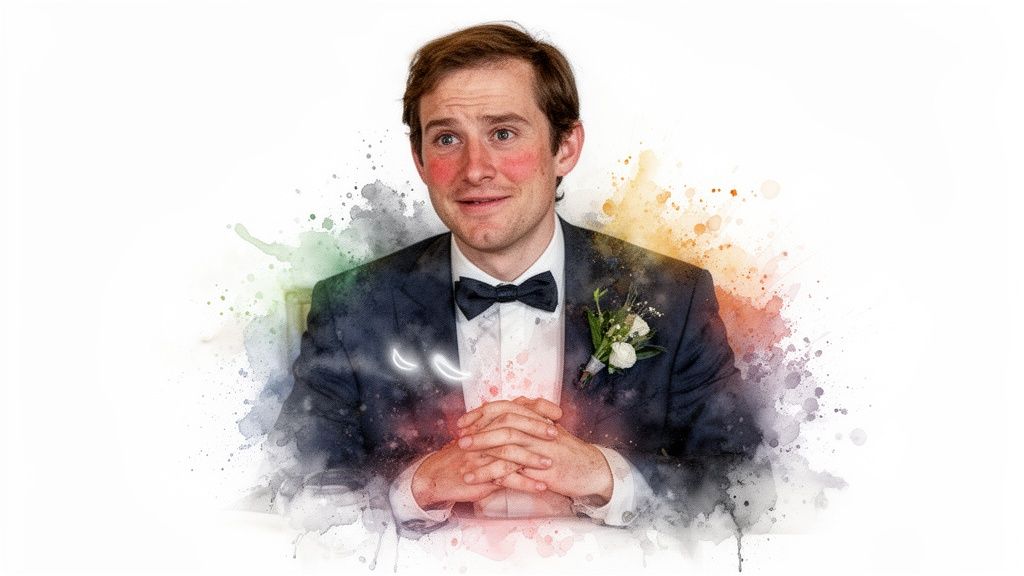
You know the moment. The dinner plates are being cleared, the champagne is poured, and a hush falls over the room. Suddenly, your name is called. In that split second, your heart starts pounding, your palms get slick, and you can’t help but wonder what you were thinking when you agreed to this.
Let me be clear: this feeling isn't a character flaw. It's a deeply human reaction to a high-stakes moment. You’re not just standing up to say a few words. You’re being asked to publicly articulate your love for two people you cherish, in front of an audience filled with everyone they cherish. The pressure is real.
But here’s something I've learned from coaching countless speakers: that wave of anxiety often comes from not having a clear plan, not from a genuine inability to speak. When your mind doesn't have a roadmap to follow, it defaults to filling in the blanks with every worst-case scenario imaginable—stumbling over words, forgetting your lines, or telling a joke that falls completely flat.
The Science Behind the Fear
If this fear feels bigger than you, you're in good company. Public speaking anxiety, or glossophobia, is one of the most common phobias out there, affecting a staggering 75% of the global population. Research on public speaking statistics shows that only about 10% of people actually enjoy it, while another 10% are genuinely terrified. The rest of us? We're somewhere in the middle, feeling the nerves but capable of pushing through.
That anxiety is your body's ancient fight-or-flight system doing its job. It sees that sea of expectant faces as a potential threat and floods your system with adrenaline. This is why you feel those classic physical symptoms:
- A racing heart: Your body is preparing you for action by pumping more blood to your muscles.
- Shaky hands or a quivering voice: That's the adrenaline causing minor muscle tremors.
- A dry mouth: Non-essential systems, like digestion, slow down to conserve energy.
Simply understanding that these are just biological signals—not a verdict on your ability—is the first crucial step toward getting them under control.
You're not meant to eliminate the nerves; you're meant to manage them. Think of that adrenaline rush not as panic, but as your body handing you the energy you need to deliver a powerful, memorable toast.
Reframing Your Nerves as Excitement
Here’s the fascinating part: the physical sensations of anxiety and excitement are nearly identical. A pounding heart, quickened breath, a rush of energy—it’s the same biological cocktail. The only real difference is how you choose to interpret it.
So, instead of telling yourself, "I'm so nervous," I want you to try actively shifting the narrative to, "I'm so excited to do this for my friend."
This simple mental flip can be a game-changer. You're not giving a performance; you are giving a gift. The nervous energy you feel is a direct measurement of how much you care about the couple, and that genuine care is exactly what will make your toast resonate with everyone in the room.
Mindset Shifts for Pre-Speech Confidence
Use this table as a quick-reference tool. It's designed to help you reframe those common anxious thoughts into positive, actionable perspectives before you give your toast.
| Anxious Thought | Confident Reframe |
|---|---|
| "What if I mess up and embarrass myself?" | "Everyone here wants me to succeed. They are cheering for me and the happy couple." |
| "I'm going to forget everything I want to say." | "I have my notes as a safety net. I know the key points I want to share." |
| "My hands are shaking. Everyone will see." | "This energy means I care deeply. I can channel it into a passionate delivery." |
| "What if nobody laughs at my joke?" | "The goal is to be heartfelt, not hilarious. The humor is just a bonus." |
| "I'm not a good public speaker." | "This isn't a performance. It's a conversation with friends celebrating a milestone." |
Remember, your goal isn't to be a flawless orator. It's to be a genuine friend. With a solid plan and the right mindset, you can channel that energy into a delivery that feels both confident and completely authentic to you.
Building a Speech That Builds Your Confidence
One of the best antidotes for speaking anxiety is having a solid plan. Truly. When you know exactly where you’re going, you’re far less likely to get lost in a fog of nerves. A well-structured speech isn't a rigid script; it’s a safety net that gives you the freedom to be yourself.
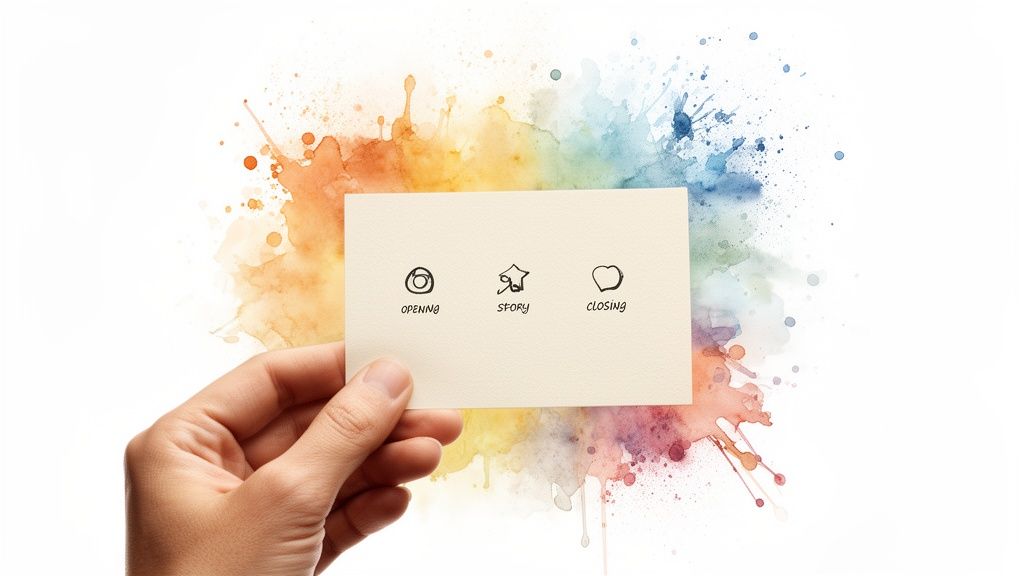
The easiest way to think about it is as a simple, three-part story. This framework is your best defense against rambling, freezing up, or losing your place. It gives you a clear path from your first word to the final "cheers!"
The Three Pillars of a Great Toast
Every memorable wedding speech, whether it's from the best man, maid of honor, or a parent, follows this same natural rhythm. It has a beginning that welcomes everyone, a middle that tells a story, and an end that celebrates the future.
A Warm Opening: This is your first impression. Your goal here is to gently grab the audience's attention and let them know who you are. Ditch the classic "For those who don't know me..." and try something more personal, like a brief, charming anecdote about how you first met the bride or groom.
A Meaningful Middle: Here’s the heart of your speech. This is where you share one story—not a list of achievements, but a single, focused narrative that reveals something true about the couple's bond. Your job is to show, not just tell, why they are so perfect for each other.
A Touching Closing: This is where you land the plane. You’ll tie your story back to the present moment, offer your sincere well-wishes for their future, and then raise your glass. It’s the final, uplifting note that leaves everyone feeling moved.
Finding Your Central Story
That middle part—the story—is where most people get stuck. The secret is to pick one specific memory that you know best and that illustrates a key quality.
If you're the father of the bride, perhaps you recall the moment you saw her partner truly care for her in a small but significant way. If you’re the maid of honor, maybe it’s a story that highlights your friend’s character and how her new spouse brings out the absolute best in her.
Don’t try to tell the couple's entire life story. Instead, zoom in on a single, meaningful memory. A specific, heartfelt moment will always be more powerful than a vague summary of their relationship.
If you’re swimming in memories and can't find a clear narrative, a tool like Wedding AI can be a huge help. It asks you thoughtful questions designed to pull out those specific details and then helps weave them into a coherent structure that feels natural and sounds just like you.
Ultimately, a strong structure does more than just organize your thoughts—it builds your confidence. When you have a roadmap, you can stop worrying about what to say and focus on delivering your words with the warmth and sincerity they deserve.
Rehearsing for Confidence, Not Memorization
So, you have a solid speech structured and written down. That’s more than half the battle right there. But the real magic happens when you take those words off the page and make them sound like you. This is where rehearsal comes in.
Let me be clear: this is not about memorizing every single word. The goal isn’t to become a perfect orator who recites lines flawlessly. The goal is to get so comfortable with your key points and stories that delivering the speech feels more like a heartfelt conversation than a stiff performance.
Think of it like telling a story you love—you know the key moments, the funny lines, and the emotional beats, but it comes out a little different each time you tell it. That’s what you’re aiming for. This deep familiarity builds unshakeable confidence.
Your Strategic Rehearsal Plan
Just reading your speech in the mirror a few times won’t cut it. You need a game plan that helps you internalize the material and find its natural rhythm.
First, just read your toast out loud to yourself. I know it sounds simple, but please don't skip this. You'll immediately hear the clunky phrases that looked brilliant on paper but feel awkward to say. This is your chance for some quick and easy edits.
Next, use your phone to record yourself. I know, nobody loves the sound of their own voice, but this is a game-changer. Listening back is like having a personal speech coach. You'll instantly spot things you'd otherwise miss:
- Pacing Problems: Are you speeding through the sentimental parts? Or perhaps dragging on a bit too long in the middle? A recording makes it obvious where to slow down for impact or inject more energy.
- Filler Words: We all have them—the "ums," "ahs," "likes," and "you knows." Hearing them on a recording is the first step to becoming mindful of them and reducing them.
- Awkward Pauses: You’ll find where a pause feels uncomfortable and where it lands with real power, giving the audience a moment to absorb what you just said.
The point of practice is to get the speech out of your head and into your body. You're building muscle memory for a calm, confident delivery that you can rely on when the wedding day adrenaline kicks in.
From Solo Practice to a Friendly Audience
Once you’re feeling good about the flow on your own, it’s time for the most critical step: practice in front of another human being. Find a trusted friend or family member—someone who will give you honest, kind feedback without making you more nervous.
This is your dress rehearsal. Ask them to watch for things like eye contact, body language, and whether your jokes or emotional beats landed as you intended. Their perspective is invaluable. This simple act of speaking to a real person starts building your connection skills.
If you used a tool like Wedding AI to help draft your speech, you can print it in a large, easy-to-read font that’s perfect for practice. Just remember, your goal isn't perfection. It’s about becoming so comfortable that you can stop worrying about the words and focus on what really matters: honoring the happy couple.
Staying Calm Moments Before You Speak

The dinner plates are gone, the champagne is poured, and you hear the DJ clearing their throat. This is it. This is the moment when all that preparation can feel miles away as the frantic beat in your chest takes over. That's okay. Even with a pounding heart, you have more control than you think.
What you do in these last few minutes can make all the difference. The goal isn’t to magically erase the adrenaline—it's to use it. You can channel that nervous energy to deliver a warm, connected toast instead of letting it send you into a panic.
And here’s the good news: all the work you've already put in has done most of the heavy lifting. A lack of preparation is a massive driver of speaking anxiety, and some studies suggest solid prep can manage up to 90% of those nerves. You can read more on how preparation impacts speaking anxiety. So, the calm you're looking for is already close.
Ground Yourself in the Present Moment
Your mind is going to try to jump ahead, playing out every worst-case scenario. Your only job is to gently pull it back to the here and now. The easiest way to do that is to focus on physical sensations, a simple trick that breaks the anxiety loop.
You can do this right at your table, and no one will ever know.
- Feel Your Feet: I'm serious. Press both of your feet flat on the floor. Pay attention to the solid ground beneath you. That simple physical connection pulls your focus out of your spiraling thoughts and back into your body.
- Engage Your Senses: Pick one tiny thing to concentrate on. Maybe it's the weight of the fork in your hand, the texture of the linen napkin, or the low murmur of conversations around you. Give your brain a specific, neutral job so it doesn't have the bandwidth to spin out.
This isn’t about pretending you’re not nervous. It’s about redirecting your focus. When you zero in on the physical world, you cut off the oxygen that fuels those anxious thoughts.
Regulate Your Breathing with the 4-7-8 Method
When you get nervous, your breathing gets fast and shallow, which just signals "panic!" to your brain. You can flip that switch by taking control of your breath. The 4-7-8 method is a powerful and completely silent tool for this.
Here’s how you do it:
- Inhale quietly through your nose for a count of four.
- Hold that breath for a count of seven.
- Exhale slowly and completely through your mouth for a count of eight.
Do this three or four times. That long exhale is the secret weapon—it stimulates the vagus nerve, which helps slow your heart rate and tells your body it's safe to relax. It’s like a biological reset button.
This isn't about "thinking positive." It's about taking concrete, physical steps to manage your body’s stress response. With these simple tools, you can stand up not as a bundle of nerves, but as a confident friend, ready to give a beautiful gift to the happy couple.
Delivering Your Toast with Poise
Alright, the moment of truth. You’re standing up, the mic feels a little strange in your hand, and a sea of faces is looking right at you. This is it. But remember, all that prep work wasn't for a performance—it was to create a gift for two people you care about. Now, you just have to give it to them.
Before you say a single word, do this one simple thing: take one slow, deliberate breath. Find the happy couple in the crowd, lock eyes for just a second, and give them a real smile. That tiny, two-second reset is your anchor. It calms your racing heart and reminds you (and everyone else) exactly why you're standing there.
Mastering Your Delivery
The secret to a great delivery isn't being perfect; it's being present. You’re not just reciting words in front of a room; you're speaking to the people in it. Here are a few practical tips to help your words land with all the warmth you intend.
Speak Slower Than You Think You Should: Adrenaline is a powerful accelerator. Your natural instinct will be to rush. I want you to intentionally slow yourself down to about 75% of your normal talking speed. It will feel painfully slow in your head, but to the audience, it will sound perfectly paced and confident.
Make Friends with the Pause: Silence can be your best friend. After you deliver a funny line or a heartfelt point, just stop for a second. That brief pause is incredibly powerful—it gives your audience a moment to laugh or let the sentiment sink in, and it gives you a chance to breathe and find your next thought.
Use Your Notes, Don't Read Them: Your notecards are a safety net, not a script. Glance down, grab your next bullet point, and then look back up at the guests. Making eye contact makes the whole thing feel like a conversation, not a recital.
If your nerves are still kicking, know that you're in good company. An astonishing statistic reveals that while nearly 90% of people with social anxiety disorder fear public speaking, only about 10% ever seek help for it. You can find more public speaking statistics on Teleprompter.com. The point is, what you're feeling is completely normal.
Projecting Confidence Through Body Language
Even if your stomach is doing flips, your body can tell a different story. And the funny thing is, when you physically project confidence, your brain starts to believe it. This isn't about faking it; it's about using your body to help your mind get on board.
Stand tall, with your shoulders relaxed and back. Try not to cross your arms or grip the microphone in a death clutch—those are defensive postures that signal nervousness. Let your hands gesture naturally, just as they would if you were telling this story to a good friend over coffee.
The most important thing you can do is focus on connection, not perfection. The audience isn't expecting a polished TED Talk; they are there to feel the love you have for the couple.
And what if you mess up? Maybe you stumble over a word or lose your place for a second. It happens to everyone. The key is not to panic. Just take a breath, flash a quick smile, find your place, and keep going. A smooth recovery shows more confidence than a flawless but rigid delivery. A little imperfection often makes a speech feel more real and heartfelt anyway.
Got Questions? Here Are Some Quick Answers for Your Wedding Toast
Working out the small details ahead of time is one of the best ways to build your confidence. Let's tackle some of the most common questions people have before giving a toast. Getting these straight will help you feel much more relaxed when it's your turn to grab the mic.
How Long Should a Wedding Toast Actually Be?
Aim for the sweet spot: three to five minutes. That's just enough time to share a great story and your best wishes without losing the crowd's attention.
Anything longer and you risk seeing guests start to fidget. Remember, there are often other speakers, dinner is waiting, and the couple is eager to get to the dancing!
For reference, a three-minute speech is about 350-450 words spoken at a natural pace. A practical tip is to time yourself during your rehearsal—it’s a simple step that shows you respect everyone’s time.
Is It Okay to Use Notes During My Speech?
Yes, one hundred percent. Using notes isn't a crutch; it's a sign that you've prepared well. Think of them as your safety net, not a script you're reading from word-for-word.
Your goal isn't to read a perfect speech. It's to connect with the couple and the audience. Your notes should help you do that, not get in the way of it.
A practical tip is to use small notecards with just your key points or the first few words of each paragraph written in large, clear font. This way, you can glance down for a quick reminder, then look right back up and make eye contact. That’s what makes a toast feel genuine.
What if I Get Overwhelmed with Emotion?
It happens, and honestly, it’s a beautiful thing. Getting a little choked up shows everyone just how much you care. It makes the moment feel real and unforgettable.
If you feel the tears coming, don't try to power through. Just pause. Take a deep, slow breath. Find your friend in the crowd, give them a small smile, and continue when you're ready.
The audience will be completely on your side. A simple, "Wow, this just means so much to me," is all you need to say. That raw moment of vulnerability often becomes the most powerful part of the speech.
Should I Include Inside Jokes in My Toast?
This is a tricky one, and where many toasts go wrong. It’s tempting to share a hilarious inside joke, but you must remember your audience. A speech full of references that only a few people understand will leave everyone else feeling confused and excluded.
If you absolutely must use one, give it context so everyone feels included.
- Don't say: "And we'll never forget what happened with the seagull in Brighton!" (Everyone else: ???)
- Do say: "I'll never forget that trip to Brighton—the one with the ridiculously bold seagull—because it showed me how you two can find humor and teamwork in even the most absurd situations."
See the difference? The second version brings everyone in on the feeling behind the memory, even if they don't know the whole story. It connects rather than excludes.
Feeling stuck turning your personal stories into a structured speech? Wedding AI can help you find the right words. It guides you with thoughtful questions to pull out your best memories and crafts them into a toast that sounds just like you, only more polished. Start your speech with Wedding AI.